AI Product Description Generator: Write Compelling Product Copy in Minutes, Not Hours

Picture a common scenario in e-commerce.
You’ve got 50 new products to list. Each one needs a description. You sit down to write them and realize… this is gonna take forever. Three hours later, you’ve written 8 descriptions and your brain is fried. You still have 42 to go.
That’s the reality for most e-commerce solopreneurs. Writing product descriptions manually doesn’t scale. You either spend days on copy, rush through it and publish garbage, or just copy the manufacturer’s description (which tanks your SEO and conversions).
Here’s what shifted: an AI product description generator can now write solid first drafts in seconds. Not perfect copy, but 70-80% of the way there. You edit, add your personality, and publish. What took 3 hours now takes 30 minutes.
We’re not talking about replacing your judgment or brand voice. We’re talking about eliminating the blank page problem and cutting description writing time by 70-90%.
In this guide, we’re breaking down why AI-generated product descriptions matter for e-commerce, which tools actually deliver quality copy, and how to create descriptions that convert browsers into buyers.
Before you explore the tools, get the blueprint that helps you use AI with clarity and structure across your entire business.
I put together The AI Blueprint for Solopreneurs – a calm, structured guide that shows you how to use AI to simplify your systems and save time without losing your voice.
👇 Enter your email below to get your free copy.
It’ll be in your inbox within minutes – practical, focused, and built to help you work smarter.
Why AI Product Description Generators Are Essential for E-Commerce
If you’re selling products online, descriptions aren’t optional. They’re the difference between a sale and a bounce. But writing them manually creates a bottleneck most solopreneurs can’t solve.
The Scale Problem
Here’s what typically happens: You launch with 10-20 products. Writing descriptions is manageable. Takes a few hours, but you get it done.
Then you add more inventory. Now you’ve got 50 products. Then 100. Then 200. Writing quality descriptions for each one becomes impossible while running everything else in your business.
The math doesn’t work. At 20-30 minutes per description (if you’re fast), 100 products = 33-50 hours of writing. That’s more than a week of full-time work just on product copy.
Conversion Impact Reality
Better descriptions directly increase sales. Data from e-commerce stores shows that detailed, benefit-focused descriptions can boost conversion rates by 30-80% compared to basic feature lists.
Why? Because good descriptions:
- Answer questions before customers ask them
- Show the value beyond just listing specs
- Build confidence in the purchase decision
- Paint a picture of owning and using the product
Weak descriptions create doubt. Strong descriptions create desire. AI helps you write strong descriptions at scale.
SEO and Discoverability
Google hates duplicate content. If you copy manufacturer descriptions, you’re competing with dozens or hundreds of other sites using identical copy. Your product pages won’t rank.
Unique AI-generated descriptions give each product page original content. That improves your chances of ranking for product-specific searches. More rankings = more organic traffic = more sales.
Plus, AI tools help you naturally include keywords customers actually search for. “Waterproof hiking backpack” instead of “outdoor carrying solution.” Real language people use.
Time Investment Calculation
Let’s run the real numbers on description writing time:
Manual approach:
- 100 products at 25 minutes each = 42 hours
- Your time valued at $50/hour = $2,100 in opportunity cost
AI-assisted approach:
- 100 products at 5 minutes each (generate + edit) = 8.5 hours
- Tool cost: $20-50/month
- Your time valued at $50/hour = $425 in opportunity cost
- Total: $445-475
You save 33-34 hours and roughly $1,650 per 100 products. That’s time you can spend on inventory, marketing, or literally anything that grows your business.
If this is showing you what’s possible, the AI Blueprint gives you a simple system for using AI across your business with clarity.
You can explore it here → See What’s Inside The AI Blueprint for Solopreneurs
Consistency Challenge
When you write 100 descriptions manually over several weeks, your voice and quality drift. Early descriptions are detailed and engaging. By number 73, you’re phoning it in with generic copy.
AI maintains consistent quality and voice across every description. You set the tone once, and it applies that style to everything. Your catalog feels cohesive instead of random.
Best AI Product Description Generator Tools
Let’s talk about tools that actually deliver quality product copy, not just generic filler.
ChatGPT for Product Copy (Free to $20/month)
ChatGPT is the most flexible option. You control exactly what you get through your prompts.
How to use it: “Write a 150-word product description for [product name]. It’s a [category] designed for [target customer]. Key features: [list]. Focus on benefits, not just features. Tone: [friendly/professional/fun]. Include why someone would choose this over alternatives.”
You get a solid first draft in 10 seconds. Edit for accuracy and personality, then publish.
Best for: Solopreneurs who want control over output and don’t mind prompt engineering.
Cost: Free version works fine for occasional use. ChatGPT Plus ($20/month) is worth it if you’re generating descriptions daily.
Jasper Product Templates ($49/month)
Jasper has pre-built templates specifically for e-commerce. You fill in product details, select your tone, and it generates multiple description variations.
What makes it useful:
- Templates designed for different product categories
- Consistent brand voice across all descriptions
- Bulk generation capability
- Built-in tone controls
Worth it if: You’re generating dozens of descriptions weekly and want specialized e-commerce templates. Not worth it if you only need descriptions occasionally.
Copy.ai Product Description Tool ($49/month)
Copy.ai focuses on quick generation with multiple variations. You input basic product info, and it gives you 5-10 different description options to choose from.
Best feature: The variation approach. You’re not stuck with one output. You pick the version that fits best or combine elements from multiple options.
When to use it: Similar pricing to Jasper. Pick based on which interface you prefer. Both do the job well.
Writesonic E-Commerce Mode ($20/month)
Writesonic offers e-commerce-specific features at a lower price point than Jasper or Copy.ai. The quality is good, and the cost makes it accessible for smaller stores.
What you get:
- Product description generation
- SEO optimization suggestions
- Multiple language support
- Bulk creation capability
Best for: Budget-conscious store owners who want specialized e-commerce AI without premium tool pricing.
Shopify Magic (Free for Shopify users)
Shopify Magic is built directly into Shopify. If you’re on that platform, you already have access to AI description generation without paying extra.
How it works: Click the “Generate text” button in any product description field. Shopify’s AI creates a description based on your product title and details.
The quality is decent. Not as good as ChatGPT with a well-crafted prompt, but totally free and convenient if you’re already on Shopify.
Understanding Product Description Psychology
Tools generate words. You need to understand what makes those words actually sell products.
Benefit Versus Feature Focus
Features are what the product has or is:
- Made from stainless steel
- 20oz capacity
- Includes lid with straw
Benefits are what those features do for the customer:
- Won’t rust or corrode, lasts for years
- Perfect size for your morning coffee or afternoon smoothie
- No spills in your car or bag
Most product descriptions list features. Good descriptions translate features into benefits. AI can do this when you prompt it correctly.
Effective prompt: “Focus on benefits and outcomes, not just specifications. Explain why each feature matters to the customer.”
Emotional Trigger Integration
People buy based on emotion and justify with logic. Your descriptions should tap into feelings.
Common emotional triggers:
- Security and safety (peace of mind)
- Belonging and status (social acceptance)
- Achievement and success (accomplishment)
- Pleasure and comfort (feeling good)
- Fear of missing out (urgency)
A waterproof phone case isn’t just waterproof. It’s “peace of mind knowing your expensive phone is protected, even if you drop it in the pool or get caught in the rain.”
Sensory Language Usage
Help customers imagine experiencing the product. Use words that engage the senses.
Weak: “Comfortable cotton t-shirt” Strong: “Soft, breathable cotton that feels broken-in from day one. Light enough for summer heat, substantial enough to avoid that cheap see-through look.”
Weak: “Scented candle” Strong: “The rich scent of vanilla and sandalwood fills your space within minutes, creating that cozy coffee shop vibe you love.”
AI tools can generate sensory language when you prompt for it: “Use sensory details. Help the customer imagine touching, seeing, smelling, or using this product.”
Problem-Solution Framing
Position your product as the answer to a specific problem.
Framework:
- Identify the problem your customer has
- Show how your product solves it
- Paint the picture of life after the problem is solved
Example: “Tired of tangled necklaces every time you travel? This jewelry case keeps each piece separate with individual compartments. Pack for a week-long trip in 60 seconds, arrive with every necklace untangled and ready to wear.”
Writing Product Descriptions for Different Categories
Different products need different approaches. What works for tech products doesn’t work for jewelry.
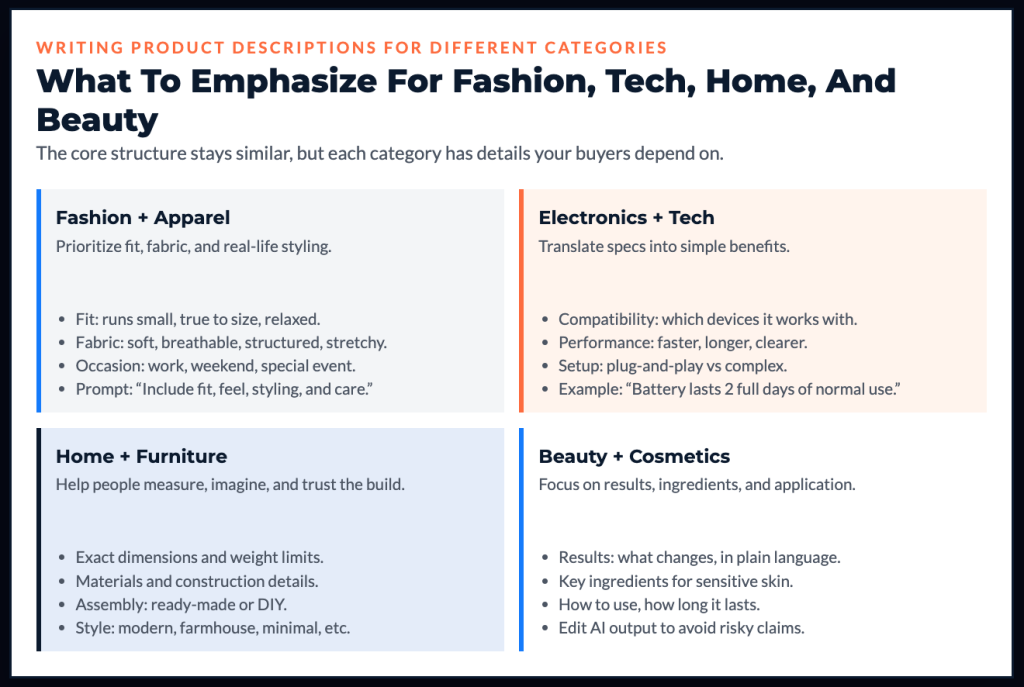
Fashion and Apparel
What matters:
- Fit and sizing (be specific: runs small, true to size, oversized fit)
- Fabric and feel (soft, stretchy, breathable, structured)
- Style and occasion (casual Friday, date night, lounging at home)
- Care instructions (machine washable, dry clean only)
AI prompt template: “Write a description for [clothing item]. Include fit details, fabric feel, styling suggestions, and care info. Tone: [your brand voice].”
Electronics and Tech
What matters:
- Compatibility (works with which devices/systems)
- Technical specs (but translated into benefits)
- Setup ease (plug and play vs. configuration required)
- Performance advantages (faster, longer battery, better quality)
Common mistake: Listing specs without explaining what they mean. “5000mAh battery” means nothing to most people. “Battery lasts 2 full days of normal use” tells them what they need to know.
Home and Furniture
What matters:
- Dimensions (exact measurements, not just “large”)
- Materials and quality (what it’s made of, how it’s constructed)
- Assembly requirements (ready to use or needs building)
- Lifestyle fit (modern minimalist, cozy farmhouse, etc.)
Critical detail: Always include dimensions. “Spacious storage bench” is vague. “48 inches wide, 18 inches tall, holds up to 100 lbs” lets customers know if it fits their space and needs.
Beauty and Cosmetics
What matters:
- Results and benefits (what it does for your skin/hair)
- Ingredients (especially for sensitive skin or allergies)
- Application and usage (how to use it, how long it lasts)
- Scent and texture (fragrance-free, lightweight, creamy)
Regulatory note: Be careful with claims. “Reduces appearance of fine lines” is safer than “eliminates wrinkles.” AI doesn’t know FDA guidelines, so review beauty product copy carefully.
Creating Feature-to-Benefit Product Copy
This is the skill that separates average descriptions from ones that convert.
Technical Specification Translation
Every technical feature should answer: “So what? Why does this matter to me?”
Feature: Waterproof to 100 feet Benefit: Take underwater photos while snorkeling without worry
Feature: 1TB storage Benefit: Store over 250,000 photos or 500 hours of HD video
Feature: Dishwasher safe Benefit: Cleanup is effortless. Just toss it in the dishwasher with your dinner dishes.
AI prompt: “For each feature, explain the practical benefit to the customer. Answer ‘why does this matter?’ for every specification.”
Use Case Scenarios
Show the product in action. Help customers visualize using it.
Example for travel backpack: “Picture this: You’re rushing through the airport, and security waves you through without unpacking. The TSA-friendly laptop compartment unzips completely flat, so your laptop stays secure without holding up the line. Back at your gate, the built-in USB port charges your phone while you wait to board. This isn’t just a backpack. It’s your travel partner that makes every trip smoother.”
Scenarios make abstract features concrete and relatable.
Lifestyle Integration
Connect the product to the customer’s daily life or aspirations.
Generic: “Stylish water bottle keeps drinks cold.” Lifestyle-focused: “Your morning smoothie stays ice-cold through your commute and workout. The sleek design looks good on your desk during Zoom calls. Evening walk with the dog? Your water is still refreshingly cold.”
You’re not just describing a water bottle. You’re describing how it fits into their day.
Optimizing Product Descriptions for SEO
Good descriptions rank in search results and bring organic traffic to your store.
Keyword Research Integration
Find out what terms customers actually use when searching for products like yours.
Tools for product keyword research:
- Google Keyword Planner (free)
- Amazon search suggestions (type your product, see autocomplete)
- Google “People Also Ask” questions
- Competitor product pages (see what they target)
Common pattern: Customers use different words than manufacturers. Manufacturer says “portable audio device.” Customers search for “bluetooth speaker.”
Natural Keyword Placement
Include your target keyword early in the description, ideally in the first sentence. Then use it naturally 1-2 more times, plus variations.
Forced: “This bluetooth speaker is the best bluetooth speaker for anyone who needs a bluetooth speaker.”
Natural: “This bluetooth speaker delivers surprisingly powerful sound for its compact size. Whether you’re at the beach, camping, or just hanging out in your backyard, the 12-hour battery keeps the music going all day.”
The keyword appears once prominently. Variations like “music” and “sound” support the topic naturally.
Long-Tail Keyword Opportunities
Target specific, lower-competition searches. These often convert better because the searcher knows exactly what they want.
Instead of: “yoga mat” (impossible to rank for) Target: “extra thick yoga mat for bad knees” (specific, achievable)
AI tools can help generate long-tail variations: “List 10 specific, detailed ways someone might search for this product.”
Product Title Optimization
Your product title is the most important SEO element. Include:
- Primary keyword
- Key differentiator
- Specific detail (size, color, material)
Weak: “Phone Case” Strong: “Waterproof iPhone 14 Pro Case with Built-in Screen Protector”
The strong version targets multiple search terms and tells customers exactly what they’re getting.
Brand Voice and Tone Consistency
Your descriptions should sound like they’re all from the same brand, not written by different people.
Voice Definition
Voice is your brand’s personality. It stays consistent across everything.
Examples:
- Patagonia: Outdoorsy, environmental, straightforward
- Apple: Innovative, simple, aspirational
- REI: Adventurous, practical, enthusiastic
- Warby Parker: Friendly, accessible, slightly witty
Define 3-5 words that describe your brand voice. Use those as guidance for all descriptions.
Tone Adaptation
Tone is how voice adapts to different situations. Your voice stays the same, but tone adjusts.
Serious product (safety equipment): Professional, reassuring tone Fun product (party supplies): Playful, excited tone
Luxury product (jewelry): Elegant, sophisticated tone
AI prompt for consistency: “Write in a [your voice descriptors] voice. Tone should be [appropriate for product type].”
Teaching AI Your Brand Voice
Most AI tools let you train them on your voice. Give examples:
- Paste 3-5 product descriptions you love (from your store or competitors)
- Tell the AI: “Write all descriptions in this style”
- Generate new descriptions with that reference
The more examples you provide, the better AI matches your voice.
Bulk Product Description Generation
When you need to generate descriptions for dozens or hundreds of products at once.
CSV and Spreadsheet Workflows
Most AI tools accept bulk input via spreadsheet. Set up your data properly:
Column structure:
- Product name
- Category
- Key features (comma-separated)
- Target customer
- Unique selling point
Export as CSV, upload to your AI tool, generate all descriptions at once.
Time saved: Instead of 100 individual prompts taking 8-10 hours, bulk generation takes 30-60 minutes plus editing time.
Template and Variable Systems
Create master templates with variables that swap for each product.
Example template: “[Product Name] is designed for [Target Customer] who needs [Primary Benefit]. Made from [Material], it [Key Feature 1] and [Key Feature 2]. Perfect for [Use Case], this [Category] [Unique Advantage].”
Variables get replaced automatically for each product. You get consistent structure with unique content.
Quality Control at Scale
When generating hundreds of descriptions, you need a review process:
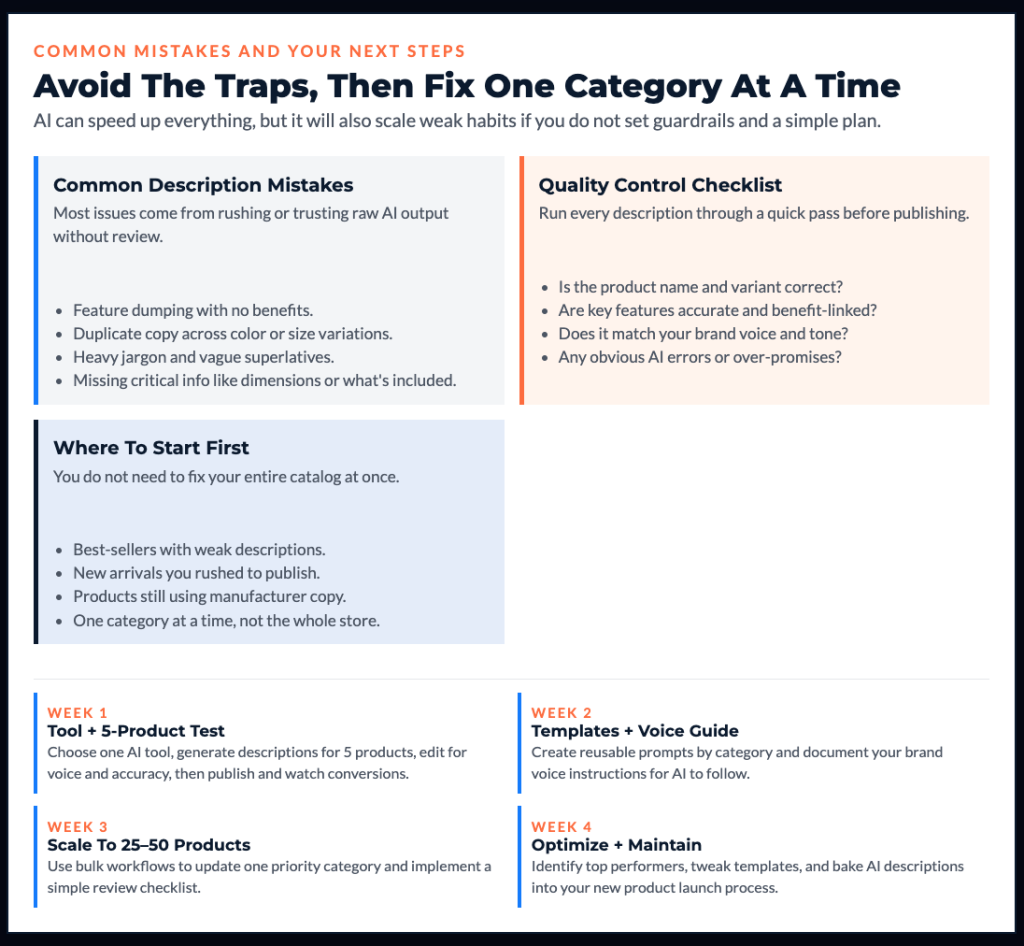
Quick review checklist:
- Product name correct?
- Key features accurate?
- No weird AI hallucinations or errors?
- Brand voice maintained?
- Call-to-action present?
Spot-check every 10th description thoroughly. Quick-scan the rest for obvious errors. This catches issues without reviewing all 200 descriptions word-by-word.
Product Description Length and Format Best Practices
How much to write and how to structure it for maximum impact.
Ideal Length Determination
Short descriptions (50-100 words):
- Simple products with few features
- Products in categories where customers know what to expect
- Impulse purchase items
Medium descriptions (100-200 words):
- Most e-commerce products
- Balance of features and benefits
- Enough detail without overwhelming
Long descriptions (200-400 words):
- Complex or expensive products
- Items requiring explanation or education
- Products with many features to highlight
AI prompt: “Write a [length] description covering [these specific points].”
Scannable Formatting
Most people scan product pages instead of reading every word. Make that easy:
Use bullet points for:
- Key features
- Specifications
- What’s included
Use short paragraphs for:
- Opening hook
- Benefits and use cases
- Closing call-to-action
Use bold text for:
- Key benefits
- Important details
- Standout features
Break up walls of text. White space improves readability and conversion rates.
Mobile-First Structure
Over 60% of e-commerce traffic comes from mobile devices. Your descriptions need to work on small screens.
Mobile formatting rules:
- Shorter paragraphs (2-3 sentences max)
- Bullet points over long paragraphs
- Most important info in first 50 words
- Clear call-to-action buttons
- Avoid fancy formatting that breaks on mobile
Test your descriptions on your phone. If you wouldn’t read it, customers won’t either.
Common Product Description Mistakes to Avoid
Here’s what typically goes wrong with AI-generated descriptions, based on common patterns.
Feature Dumping
Just listing specifications without explaining benefits loses customers.
Mistake: “Features: 5000mAh battery, USB-C charging, 6.1-inch display, 128GB storage, 5G capable, water-resistant IP68 rating.”
Better: “The 5000mAh battery lasts two full days of normal use. Fast USB-C charging gets you from 0 to 50% in 30 minutes. The 6.1-inch display is big enough for videos, small enough to fit comfortably in your pocket. Store over 30,000 photos with 128GB of space.”
Translate every spec into what it means for the customer.
Duplicate Content
Using the same description across multiple product variations tanks your SEO and looks lazy.
Example of duplication: You sell t-shirts in 5 colors. Don’t use identical descriptions except for the color name. Each product page needs unique content.
Solution with AI: Generate unique descriptions that emphasize different aspects or use cases for each variation. Blue version targets beach/summer. Black version targets work/professional. Red version targets bold statement-makers.
Jargon Overload
Using industry terms customers don’t understand creates confusion.
Technical jargon: “Featuring a 3-axis gimbal with 360-degree rotation capability and active stabilization algorithm.”
Clear language: “Built-in stabilization keeps your videos smooth, even when you’re walking or moving. The camera stays steady while you capture the action.”
AI often defaults to technical language. Edit to make it accessible.
Excessive Superlatives
Overusing “best,” “amazing,” “revolutionary,” and “incredible” destroys credibility.
Over-hyped: “This is the most amazing, revolutionary, life-changing water bottle you’ll ever use! Absolutely incredible!”
Credible: “This water bottle keeps drinks cold for 24 hours, even in 90-degree heat. The leak-proof lid has never failed in three years of daily use by thousands of customers.”
Specific details beat vague superlatives every time.
Missing Critical Information
When describing tools that let you use an AI product description generator effectively, always include complete details that help customers make informed decisions without having to contact support.
Checklist of critical info:
- Exact dimensions or sizes
- Material and construction details
- What’s included (and what’s not)
- Assembly or setup requirements
- Care and maintenance needs
- Warranty or guarantee info
- Compatibility requirements
Missing any of these creates friction. Friction kills conversions.
Your Action Plan: Start Creating Better Descriptions This Week
Alright, you’ve got the framework. Here’s how to actually implement this in your store.
Week 1: Setup and Testing
- Pick one AI tool to test (ChatGPT free version is fine to start)
- Choose 5 products from your catalog
- Generate descriptions using the frameworks in this guide
- Edit for accuracy, voice, and personality
- Publish and track conversion rates
- Total time: 2-3 hours
Week 2: Template Development
- Based on what worked in week 1, create reusable prompts
- Build templates for your main product categories
- Document your brand voice guidelines for AI
- Test bulk generation with 10-15 products
- Total time: 3-4 hours
Week 3: Scale Up
- Generate descriptions for 25-50 products
- Implement quality control process
- Update existing weak descriptions
- Track impact on conversion rates and SEO
- Total time: 4-6 hours
Week 4: Optimize and Refine
- Review which descriptions perform best
- Adjust templates based on results
- Fill in remaining product gaps
- Set up ongoing process for new products
- Total time: 2-3 hours
Total investment: 11-16 hours to transform your entire product catalog
The Products That Need Attention First
What’s the one product category in your store with the weakest descriptions right now?
Not all of them. Just one category.
Maybe it’s:
- Your best-sellers with thin, generic copy
- New products you rushed to publish
- Inventory that’s not converting well
- Products with manufacturer descriptions you copied
Start there. Use AI to create better descriptions for that one category. Measure the impact. Then move to the next category.
Remember This
Product descriptions aren’t about flowery writing or clever wordplay. They’re about helping customers understand what they’re buying and why they should buy it from you.
AI tools don’t replace your product knowledge or understanding of your customers. They eliminate the blank page problem and speed up the writing process dramatically.
The e-commerce stores winning aren’t the ones with the most expensive copywriters. They’re the ones using AI strategically to create clear, detailed, benefit-focused descriptions at scale.
Don’t let weak descriptions kill your conversion rates. Use AI to create copy that actually sells.
As you scale your catalog, use the AI Blueprint to build a simple workflow that turns AI into a daily business advantage.
I put together The AI Blueprint for Solopreneurs – a calm, structured guide that shows you how to use AI to simplify your systems and save time without losing your voice.
👇 Enter your email below to get your free copy.
It’ll be in your inbox within minutes – practical, focused, and built to help you work smarter.
Here’s My Question For You:
What’s the one product in your store that would benefit most from a better description right now?
Not your entire catalog. Just one product.
Use the tools and frameworks in this guide to create a killer description for that one product this week. Publish it. Track what happens to its conversion rate over the next 30 days.
That’s how you learn what works for your specific products and audience.
Perfect descriptions don’t exist. But clear, benefit-focused descriptions that help customers make confident purchase decisions? Those increase sales every single time.
Your future self (the one with higher conversion rates and more sales) is gonna thank you for starting today.
Now go write some descriptions that actually sell.