AI Blog Ideas Generator: Never Stare at a Blank Screen Again

Picture Tuesday morning at 9 AM.
You know you need to publish a blog post this week. Actually, you should’ve published one last week too, but you couldn’t think of what to write about. You sit down with coffee and open a blank document.
Thirty minutes pass. The cursor blinks. You’ve typed and deleted three different opening paragraphs. Nothing feels right. You check email. Browse social media. Research “blog topic ideas.” Find lists of generic suggestions that don’t fit your niche.
An hour gone. Still no idea. Maybe you’ll write something tomorrow.
Except tomorrow, the same thing happens. And the next day. Your blog sits dormant for another month while competitors consistently publish and grow their organic traffic.
Here’s what shifted for solopreneurs using an AI blog ideas generator: they go from “I can’t think of anything to write” to having 50+ validated topic ideas in 20 minutes. Not generic topics everyone else covers, but specific, strategic ideas tailored to their audience and business goals.
The blank page problem disappears. The consistency challenge becomes manageable. Your content strategy actually happens instead of staying in your head.
In this guide, we’re breaking down exactly how to use AI tools to generate blog ideas that actually resonate with your audience, the workflows that turn random brainstorming into strategic content planning, and how to validate ideas before spending hours writing posts nobody reads.
If your blog publishing is inconsistent because idea generation feels impossible, this is your roadmap to never being stuck again.
Before you plan your next content push, get the simple 3-step framework that turns visibility into consistent client flow.
The Predictable Client Flow breaks down the 3-step framework for creating steady, repeatable client growth without overcomplicating your marketing.
👇 Enter your email below to get it instantly.
You’ll get the full framework in your inbox – clear, focused, and easy to follow.
Why AI Blog Ideas Generation Matters for Solopreneurs
Idea generation isn’t a luxury problem. For solopreneurs trying to build authority and organic traffic, it’s the bottleneck that kills content marketing before it starts.
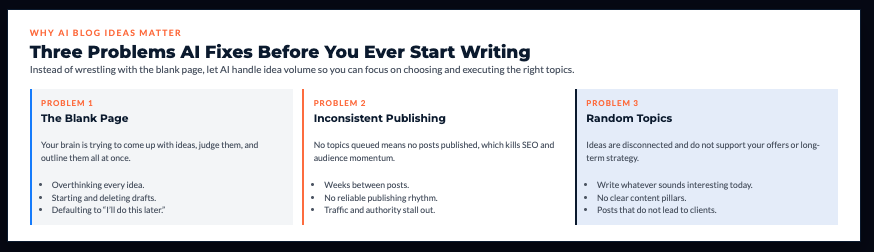
The Blank Page Problem
Here’s what typically happens: you block time to write. You open your document. Then… nothing. Your mind goes blank. Everything feels either too obvious, too complex, or already covered by someone else.
The issue isn’t writer’s block. The issue is that your brain is trying to do three things at the same time:
- Come up with topic ideas
- Evaluate if they’re good
- Structure how you’ll write them
That’s cognitive overload. AI separates these tasks. It generates dozens of options. You evaluate and choose. Your brain can then focus entirely on writing quality content.
Content Consistency Challenge
SEO rewards consistent publishing. Algorithms favor sites that regularly add fresh, quality content. Audience building requires showing up reliably.
Reality check:
- Publishing weekly builds momentum
- Publishing monthly loses momentum
- Publishing sporadically might as well be not publishing
The problem? Consistent publishing requires consistent ideation. That’s where most solopreneurs fail – not in the writing, but in having ideas ready to write about.
In my experience working with solopreneurs: The ones publishing consistently aren’t necessarily better writers. They’ve solved the ideation problem so execution becomes the only challenge.
Strategic Content Planning
Random topics don’t build businesses. Strategic topics do.
Random content approach:
- “I’ll write about whatever I think of”
- No connection between posts
- Unclear path to business goals
- Feels productive but drives no results
Strategic content approach:
- Topics align with business objectives
- Posts build on each other
- Clear conversion paths
- Each post serves a purpose
AI helps you shift from reactive topic selection to intentional content strategy by generating ideas based on your goals, not just what seems interesting today.
SEO and Discoverability
The difference between a blog post that gets 50 views and one that gets 5,000 often comes down to topic selection, not writing quality.
High-traffic topics:
- Match what people actually search for
- Fill gaps in existing content
- Target achievable keyword difficulty
- Answer questions people ask
Low-traffic topics:
- Interesting to you but nobody searches
- Already covered exhaustively by competitors
- Too broad or too narrow
- Solve problems nobody has
AI tools help identify high-potential topics by analyzing search data, competition, and audience behavior – not just guessing what might work.
Best AI Tools for Generating Blog Ideas
Let’s get specific about which tools actually deliver useful topic ideas.
ChatGPT for Blog Brainstorming (Free – $20/month)
ChatGPT is your starting point. It generates dozens of topic ideas from simple prompts.
Effective prompt:
“Generate 30 blog post ideas for [your niche] targeting [your audience]. Topics should:
- Solve specific problems
- Be achievable in 1,500-2,000 words
- Have clear search intent
- Vary between how-to, listicles, and guides
- Avoid obvious, oversat
urated topics
Format: Title, brief description, target keyword”
What you get: Comprehensive list of specific, actionable topics in 2-3 minutes.
Advanced technique: Give ChatGPT examples of your best-performing posts and ask it to generate similar topics with different angles.
Claude for Strategic Ideation (Free – $20/month)
Claude excels at deeper strategic thinking about content direction.
Use Claude when:
- Planning quarterly content themes
- Developing content series
- Analyzing competitor content gaps
- Creating editorial calendar structure
Strategic prompt:
“I run a [business type] blog. My goal is [business objective]. Analyze my content strategy and recommend:
- 5 content pillars to build around
- Topic clusters under each pillar
- Priority order based on impact
- Content gaps to fill first”
Frase Content Briefs ($15/month)
Frase generates blog ideas based on actual search data and competitor analysis.
What it does:
- Analyzes top-ranking content for keywords
- Suggests related topics
- Shows search volume and difficulty
- Identifies questions people ask
- Recommends content structure
Best for: SEO-focused solopreneurs who want data-driven topic selection, not just creative brainstorming.
Surfer SEO Content Planner ($29/month)
Surfer helps identify blog topics that can actually rank.
Process:
- Enter seed keyword
- Surfer suggests related topics
- Shows difficulty score for each
- Recommends which to tackle first
- Creates content brief for chosen topics
Value: You’re not just generating ideas – you’re generating rankable ideas.

Using Search Data to Generate Blog Ideas with AI
Creative brainstorming is one thing. Data-driven ideation is another. Combine them for best results.
Google Keyword Planner + AI Analysis
Workflow:
- Use Google Keyword Planner to find keywords in your niche
- Export data (keywords, search volume, competition)
- Paste into ChatGPT with prompt: “Analyze these keywords. Which ones should I create blog posts about? Prioritize by: search volume, competition, relevance to [your business]. Suggest specific blog post titles.”
Time investment: 15-20 minutes for months of validated topic ideas.
AnswerThePublic Integration (Free tier, $99/month pro)
AnswerThePublic shows real questions people search.
AI enhancement workflow:
- Search your topic in AnswerThePublic
- Export questions
- Feed to ChatGPT: “Turn these questions into comprehensive blog post titles. Group related questions together into single posts where appropriate.”
Result: Topics based on actual search behavior, not assumptions.
AlsoAsked for Topic Expansion ($9/month)
AlsoAsked reveals related questions from Google’s “People Also Ask” feature.
Use case: You have one good topic idea. AlsoAsked shows 20 related questions. Each question becomes a potential blog post or section within a comprehensive guide.
AI layer: Use ChatGPT to organize these questions into a logical content series.

Audience Research for Better Blog Ideas
Search data tells you what people ask. Audience research tells you why they care.
Social Listening with AI
Manual social listening:
- Browse Reddit, Twitter, LinkedIn groups
- Note common questions and complaints
- Identify recurring themes
AI enhancement: Paste collected discussions into ChatGPT:
“Here are discussions from my target audience [paste content]. What blog topics would address their main concerns? What questions are they repeatedly asking?”
Reddit and Forum Mining
High-value subreddits for topic ideas:
- Your industry-specific subreddits
- Related r/entrepreneur, r/solopreneurs
- Problem-focused communities
What to look for:
- Highly upvoted questions
- Long threads with lots of discussion
- Recurring topics
- Problems without good solutions
AI analysis: “Analyze these Reddit threads. What blog post topics would best serve this audience? What information gaps exist?”
Customer Interview Analysis
If you’ve talked to customers:
- Record common questions they ask
- Note problems they mention
- Identify knowledge gaps
AI prompt: “Based on these customer conversations [summarize themes], what blog topics would be most valuable? Prioritize topics that lead toward my offer: [your product/service].”

AI Prompts and Frameworks for Blog Ideation
Better prompts = better ideas. Here are frameworks that consistently work.
The Problem-Solution Framework
Prompt structure:
“My audience [description] struggles with [specific problem]. Generate 15 blog post ideas that:
- Address this problem from different angles
- Offer actionable solutions
- Range from beginner to advanced
- Include quick wins and comprehensive guides”
Why it works: Problem-focused content attracts people actively seeking solutions.
Question-Based Prompts
Prompt:
“Generate blog post ideas in these formats for [topic]:
- 10 ‘How to…’ posts
- 10 ‘What is…’ posts
- 10 ‘Why…’ posts
- 10 ‘When…’ posts”
Result: 40 topic ideas covering different search intents.
Listicle Generation
Prompt:
“Create 15 list-based blog post titles for [niche]. Include:
- Tools and resources lists
- Tips and strategies lists
- Mistakes to avoid
- Best practices
- Examples and case studies”
Why listicles matter: They’re easy to write, easy to consume, and perform well in search.
Contrarian Angle Generation
Prompt:
“What are common beliefs in [your niche]? For each, generate a blog post that challenges or provides a contrarian perspective. Make titles provocative but not clickbait.”
Example output:
- Common belief: “You need to post daily on social media”
- Contrarian post: “Why Posting 3x Weekly Gets Better Results Than Daily Posting”

Organizing Blog Ideas into Content Strategy
When you’re exploring how AI blog ideas generator tools can transform your content strategy, organization is key – having 100 random topic ideas is overwhelming, but having them organized into strategic clusters makes execution simple.
Content Pillar Identification
Use AI to identify pillars:
“I write about [general topic]. What are 3-5 content pillars I should build my blog around? Each pillar should:
- Support my business goal: [your goal]
- Interest my target audience: [audience description]
- Provide enough variety for 20+ posts
- Differentiate from competitors”
Example for business coach:
- Pillar 1: Client Acquisition
- Pillar 2: Service Delivery
- Pillar 3: Business Operations
- Pillar 4: Mindset & Growth
Every blog post fits into one pillar. This creates structure and authority.
Topic Clustering for SEO
Cluster strategy:
- One comprehensive pillar post (2,500+ words)
- 8-10 supporting posts (1,000-1,500 words)
- All interlinked
- Targeting related keywords
AI prompt:
“Create a topic cluster around [main topic]. Include:
- 1 pillar post title (comprehensive guide)
- 10 supporting post titles (specific subtopics)
- How each post should link together
- Target keywords for each”
If you want your content ideas to consistently lead to clients, this framework shows you exactly how to make that happen.
You can see the steps here → Get The Predictable Client Flow Framework
Content Funnel Mapping
Align topics with buyer journey:
Awareness stage (60% of content):
- Educational content
- Problem identification
- Industry insights
- No selling
Consideration stage (30%):
- Solution comparisons
- Your approach explained
- Case studies
- Soft positioning
Decision stage (10%):
- Direct comparison with alternatives
- Pricing and packages
- Implementation guides
- Success stories
AI help: “Classify these blog ideas [paste list] by funnel stage. Suggest which stage each serves and rebalance if needed.”
Validating and Refining AI-Generated Blog Ideas
Not every AI-generated idea is worth writing. Here’s how to validate before investing hours.
Search Volume Validation
Check if people actually search for your topic:
- Use Google Keyword Planner (free)
- Or Ahrefs/Semrush (paid)
- Or Ubersuggest (freemium)
Minimum viable search volume:
- Broad topics: 500+ monthly searches
- Niche topics: 100+ monthly searches
- Ultra-niche: 50+ is sufficient
No search volume? Either reframe the topic or skip it unless it’s strategically important.
Competition Analysis
Use AI to assess competition:
“Search for [your blog topic idea]. Analyze the top 10 results. Can a solo blogger with [describe your authority level] realistically rank for this? What would make my angle different enough to compete?”
Red flags:
- All results from major publications
- Every post is 5,000+ words
- Domain authorities all 70+
Green flags:
- Mix of smaller blogs ranking
- Content gaps in existing posts
- Opportunity for better explanations
Conversion Potential Assessment
Ask yourself:
- Does this topic relate to my offer?
- Would someone reading this be a potential customer?
- Can I naturally mention my product/service?
- Does it qualify or educate buyers?
Not every post needs direct conversion potential, but avoid topics completely unrelated to your business goals.
Expanding Single Topics into Multiple Blog Posts
One good idea can become 5-10 posts with strategic expansion.
Subtopic Extraction
AI prompt:
“Take this blog topic: [broad topic]. Break it down into 8-10 separate, focused blog posts. Each should cover one specific aspect in detail.”
Example:
- Broad: “Social Media Marketing for Small Business”
- Extracted subtopics:
- “Instagram vs. Facebook: Which Should Small Businesses Prioritize?”
- “How to Create a Social Media Content Calendar in 2 Hours”
- “5 Social Media Mistakes That Cost Small Businesses Customers”
- [7 more specific posts]
Format Variation
One topic, multiple formats:
- Ultimate Guide (comprehensive)
- Quick Start Guide (beginner-focused)
- Advanced Strategies (expert-level)
- Common Mistakes (what to avoid)
- Case Study (real example)
- Tool Comparison (resources)
- Step-by-Step Tutorial (implementation)
AI prompt: “Take this topic [topic]. Generate 5 different blog post angles using different formats.”
Depth Level Adaptation
Scale topics for different skill levels:
- Beginner: “Introduction to [Topic]: What You Need to Know”
- Intermediate: “Beyond the Basics: Advanced [Topic] Strategies”
- Expert: “[Topic] Deep Dive: Techniques for Experienced [Audience]”
Same core topic, different depth, different audience.
Avoiding Common Blog Idea Generation Mistakes
Based on patterns I’ve observed, here are the traps to avoid.
Generic Topic Syndrome
The mistake: Generating topics everyone else has covered without unique angles.
Example of generic:
- “How to Start a Blog”
- “10 Social Media Tips”
- “Why Email Marketing Matters”
Better with specific angles:
- “How to Start a Niche Blog in [Industry] Without Technical Skills”
- “10 Social Media Strategies That Work When You Hate Being on Camera”
- “Why Email Marketing Converts 3x Better Than Social for [Specific Audience]”
AI fix: Always add context to prompts: “Generate blog ideas for [specific niche] targeting [specific audience] with [specific problem].”
Search Volume Obsession
The mistake: Only writing about high-volume keywords, ignoring strategic low-volume topics.
Reality: A topic with 50 monthly searches that attracts your exact ideal customer is more valuable than 5,000 searches from people who’ll never buy.
Balance: 70% proven demand (decent search volume), 30% strategic topics (low volume but high conversion potential).
Ignoring Your Unique Angle
The mistake: Using AI to generate ideas, then writing like everyone else.
The fix: After AI generates topics, ask: “What’s my unique perspective on this? What do I know from experience that others don’t?”
Your angle is what makes commoditized topics worth reading.
Idea Hoarding Without Execution
The mistake: Generating hundreds of ideas but never writing posts.
What I’ve seen happen: Solopreneurs spend hours collecting ideas, organizing them beautifully, then feel overwhelmed and write nothing.
The fix: Generate 10 ideas. Write 5 of them. Then generate 10 more. Alternate between ideation and execution.
Your Game Plan: Generate Your Next 30 Blog Topics This Week
Let’s make this immediately actionable.
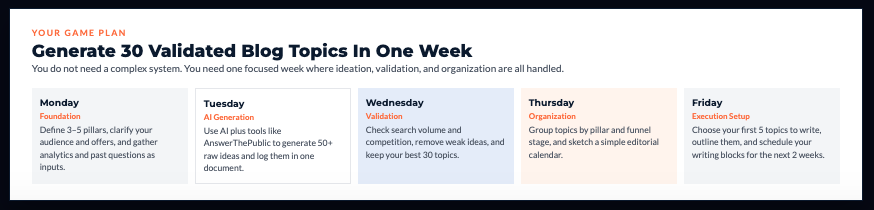
Monday: Foundation (1 hour)
- Define your content pillars (3-5 core themes)
- Identify target audience pain points
- List your business goals
- Gather any existing data (analytics, customer questions)
Tuesday: AI Generation Session (1.5 hours)
- Use ChatGPT to generate 50 topic ideas
- Use AnswerThePublic for question-based topics
- Browse Reddit/forums for real audience questions
- Compile everything in one document
Wednesday: Validation (2 hours)
- Check search volume for top 30 ideas
- Assess competition level
- Eliminate duplicates and low-potential topics
- Rank remaining by priority (impact + ease)
Thursday: Organization (1.5 hours)
- Group topics by content pillar
- Assign to funnel stages
- Create simple editorial calendar
- Note any topic clusters or series
Friday: Execution Planning (1 hour)
- Choose first 5 topics to write
- Create brief outlines for each
- Schedule writing time
- Celebrate having 30 days of blog topics ready!
Total time investment: 7 hours Result: 30 validated, organized blog topics ready to write
The Blog Topics That Matter Most
What’s the intersection of these three things?
- Topics your audience actually searches for
- Topics you can write with authority
- Topics that lead toward your offers
That’s your sweet spot. Start there.
Don’t generate 100 random ideas. Generate 20 strategic ideas in your sweet spot. Write those. Then generate 20 more.
Remember This
The solopreneurs with successful blogs aren’t necessarily better writers or smarter marketers.
They’ve solved the ideation problem so they can focus energy on execution instead of constantly figuring out what to write about.
AI tools don’t make you a better writer. They remove the blank page paralysis that was preventing you from writing at all.
Idea generation is a solvable problem. Once solved, consistency becomes the only challenge.
And consistency? That’s just showing up and doing the work.
As you build momentum with your blog, use this 3-step flow to turn that visibility into consistent client conversations.
The Predictable Client Flow breaks down the 3-step framework for creating steady, repeatable client growth without overcomplicating your marketing.
👇 Enter your email below to get it instantly.
You’ll get the full framework in your inbox – clear, focused, and easy to follow.
Here’s My Question For You:
What’s the one content pillar you’re going to build your next 10 blog posts around?
Not three pillars. Just one.
Use the tools and prompts in this guide to generate 10 specific topic ideas within that pillar this week. Write the first one. See how it performs. Write the second.
Build momentum with focused execution, not scattered ideation.
Your future self – the one with a consistently growing blog driving organic traffic and leads – is gonna thank you for starting today.
Now go generate some blog topics.