AI Competitor Analysis Tools: Know What Your Competition Is Doing (Without the Guesswork)

Here’s a scenario that plays out constantly.
A solopreneur launches a new service. They set their pricing based on what “feels right.” They create content based on what they think people want. They market on the platforms that seem popular.
Six months later, they’re struggling. Turns out their competitor charges 30% less and still makes good money. Another competitor has a completely different content strategy that’s crushing it. A third competitor dominates a platform they never even considered.
All of that info was sitting there, public and available. They just didn’t know how to find it or what to look for.
That’s where AI competitor analysis tools changed the game. What used to require expensive market research firms or hours of manual detective work can now be done in minutes. You can see competitor traffic, keywords they rank for, ads they’re running, content that performs well, and pricing strategies, all without leaving your desk.
We’re not talking about obsessing over competitors or copying what they do. We’re talking about making smarter decisions based on what’s actually working in your market instead of guessing.
In this guide, we’re breaking down why competitor analysis matters for solopreneurs, which AI tools actually deliver value, and how to turn competitor data into decisions that move your business forward.
Before you dive into the tools, get the blueprint that shows how to use AI to simplify your systems and decisions.
I put together The AI Blueprint for Solopreneurs – a calm, structured guide that shows you how to use AI to simplify your systems and save time without losing your voice.
👇 Enter your email below to get your free copy.
It’ll be in your inbox within minutes – practical, focused, and built to help you work smarter.
Why AI Competitor Analysis Is Critical for Solopreneurs
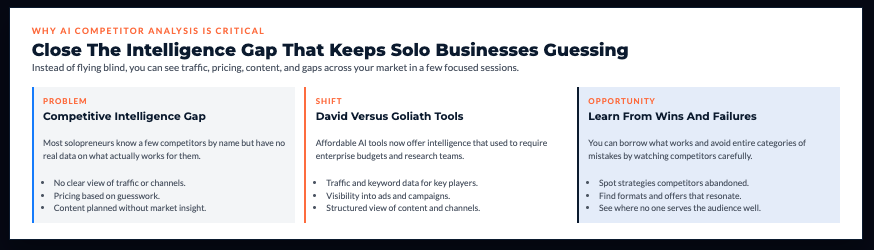
When you’re running solo, you don’t have a team doing market research. You don’t have quarterly strategy meetings where someone presents competitor insights. You’re making decisions based on limited information, which means you’re probably missing opportunities or making avoidable mistakes.
The Competitive Intelligence Gap
Most solopreneurs know their direct competitors exist. But they don’t know:
- How much traffic competitors actually get
- Which keywords drive that traffic
- What content performs best for them
- How they structure their pricing
- Which marketing channels work for them
- What their customers complain about
- Where they’re vulnerable
That gap in knowledge costs you money. You’re making strategic decisions blind while competitors might be using data to guide their moves.
David Versus Goliath Advantage
Big companies have market research teams and expensive tools. You don’t. But here’s what shifted: AI tools brought the same intelligence capabilities to solopreneurs at prices that actually make sense.
For $50-200 per month, you can access competitor data that would’ve cost $10,000+ to compile manually five years ago. That’s not a small advantage. That’s the entire playing field shifting.
Learning From Competitors’ Failures
Here’s what typically happens when solopreneurs skip competitor research: they make the same mistakes competitors already made and learned from. They launch features nobody wants. They target keywords that don’t convert. They invest in channels that don’t work for their audience.
Watching what competitors try and fail at saves you months of wasted effort. If three competitors all tried and abandoned a specific strategy, that’s a signal. Maybe that approach doesn’t work in this market, or maybe the timing isn’t right.
You don’t have to experience every failure yourself. Learn from theirs.
Spotting Market Gaps
The best opportunities often hide in plain sight. Competitors might all be focused on one segment while completely ignoring another. They might all create the same type of content while a different format would kill it. They might all have the same pricing structure, leaving room for a different model.
AI tools help you spot these gaps systematically instead of stumbling across them randomly.
Example from working with solopreneurs: One business owner analyzed five competitors in the online course space. All of them offered similar course structures and pricing. But AI analysis of customer reviews showed people consistently wanted more implementation support after the course. Nobody was offering that. She built a course plus implementation program and immediately differentiated herself. That gap was sitting there the whole time, visible in public reviews.
Resource Allocation Wisdom
When you’ve got limited time and money, you can’t afford to experiment endlessly. You need to focus on what’s most likely to work.
Competitor analysis shows you where to place your bets. If organic search drives 70% of competitor traffic, that’s where you focus SEO efforts. If their email list is their main revenue driver, you prioritize list building. If they’re crushing it on one platform and ignoring others, you’ve identified both an opportunity and a warning.
Best AI Competitor Analysis Tools
Let’s talk specific tools. Not all 50 options floating around. Just the ones that deliver real value for solopreneurs.
Semrush Competitive Research ($139/month)
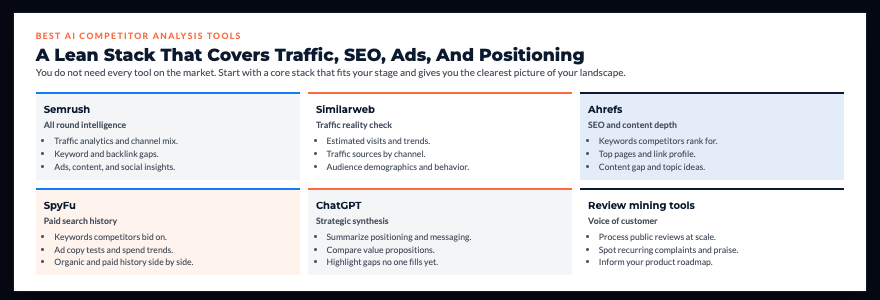
Semrush is the all-in-one option. SEO, advertising, content, social media. All competitor intel lives in one platform.
What you get:
- Traffic analytics showing visitor numbers and sources
- Keyword gap analysis (terms they rank for that you don’t)
- Backlink comparisons
- Advertising spend estimates
- Content performance tracking
- Social media monitoring
Best for: Established solopreneurs who need total competitor visibility and are willing to invest in one big tool.
When to skip it: You’re pre-revenue or just starting. Use cheaper tools first, upgrade when competitor intel becomes business-critical.
Similarweb ($125/month, free tier available)
Similarweb shows you competitor website traffic without needing access to their analytics.
Key insights:
- Total monthly visits and traffic trends
- Traffic sources (organic, paid, social, referral, direct)
- Audience demographics (age, gender, interests)
- Top referring sites
- Popular pages
- Competitor comparisons side by side
The free tier gives you basic data. Enough to see if a competitor’s success is real or just good marketing.
Use case: You hear about a competitor dominating your space. Similarweb shows they get 3,000 monthly visits. That’s not domination. That’s just loud marketing. Now you know the reality.
Ahrefs Site Explorer ($129/month)
Ahrefs specializes in SEO and content intelligence. Best tool for understanding what ranks and why.
What it reveals:
- Every keyword competitors rank for
- Their backlink profile (who links to them)
- Top-performing content by traffic
- Content gaps (topics they cover that you don’t)
- Domain authority comparison
- Ranking history and trends
Worth it if: SEO is your primary traffic strategy and you need deep competitor keyword and link data.
SpyFu ($39/month)
SpyFu focuses on paid search and SEO history. Shows you not just current data but years of history.
What you learn:
- Every keyword they’ve bought on Google Ads
- Their ad copy variations and testing
- Estimated ad spend over time
- Organic keyword rankings historically
- SEO wins and losses
Strategic value: You see competitor experiments without spending your own ad budget testing. Their successful ads become your starting templates.
ChatGPT for Competitor Strategy (Free to $20/month)
Here’s what most people miss: ChatGPT is excellent for analyzing competitor positioning and strategy.
Workflow:
- Gather competitor website copy, about pages, service descriptions, pricing pages
- Paste into ChatGPT with prompt: “Analyze these 3 competitors. What’s each one’s value proposition? Who do they target? How do they differentiate? What gaps exist that none of them fill?”
- You get strategic analysis in seconds
This costs nothing beyond ChatGPT Plus if you already have it, and it delivers insights that would cost thousands from a consultant.
Analyzing Competitor Website Traffic with AI
Traffic numbers matter because they tell you if competitor success is real or just perception.
Traffic Volume and Sources
Similarweb and Semrush both estimate monthly visitors. The numbers aren’t perfectly accurate (they’re based on panels and algorithms), but they’re close enough to inform decisions.
More important than total traffic: where it comes from.
Traffic source breakdown:
- Organic search (40%+): They’re winning at SEO. Study their keywords and content.
- Direct traffic (30%+): Strong brand recognition or loyal audience. Check their email and content strategy.
- Paid search (20%+): Heavy ad investment. Use SpyFu to see their keywords and ads.
- Social (15%+): Strong social presence. Analyze which platforms and content types.
- Referral (10%+): Good partnerships or PR. See who’s linking to them.
This breakdown tells you where to focus. If organic search drives most competitor traffic but you’re focused on social media, you’re fighting the wrong battle.
If all this data feels overwhelming, the AI Blueprint will help you use AI in a calm, structured way across your business.
You can explore it here → See What’s Inside The AI Blueprint for Solopreneurs
Audience Demographics and Behavior
Understanding who visits competitor sites helps you know if you’re targeting the same audience or a different segment.
What AI tools reveal:
- Age ranges of visitors
- Geographic distribution
- Gender split
- Interests and affinities
- Other sites they visit
- Device preferences (mobile vs. desktop)
Strategic application: If competitor audiences skew younger than yours, your messaging should differ. If they’re more international and you’re focused on one country, that’s a differentiation point. If they’re mostly mobile users and you haven’t optimized for mobile, you’ve found a competitive weakness.
Engagement Metrics
Bounce rate, pages per session, and average visit duration tell you if competitors are actually engaging their traffic or just getting clicks.
Low bounce rate (under 40%) and high pages per session (3+) signal quality traffic and good content. High bounce rate (70%+) means traffic quality is poor or content doesn’t match what people expect.
This helps you understand which competitors are real threats versus which ones just have traffic volume without engagement.
AI-Powered SEO Competitor Analysis
SEO is where AI competitor analysis really shines. You can reverse engineer exactly what’s working for competitors and replicate or improve on it.
Keyword Gap Analysis
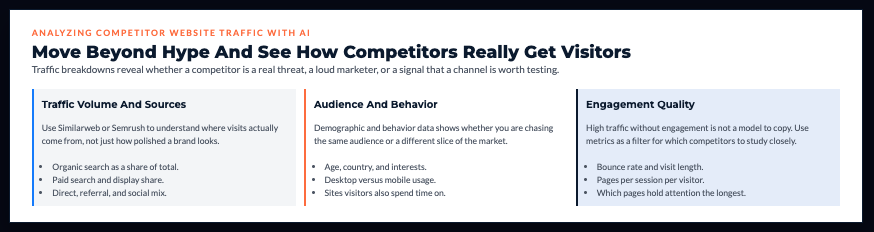
This is probably the single most valuable competitor analysis feature. You enter your domain plus 2-3 competitor domains, and AI shows you every keyword they rank for that you don’t.
In Ahrefs or Semrush:
- Enter your site and competitor sites
- Run keyword gap analysis
- Filter for keywords with reasonable difficulty (under 40)
- Look for keywords with commercial intent
- Prioritize by search volume and relevance
You just got a list of proven opportunities. These keywords already drive traffic to competitors. You’re not guessing if they work because competitors are succeeding with them.
Content Performance Tracking
AI tools show you which competitor content gets the most organic traffic.
Ahrefs Top Pages report:
- Lists competitor’s highest-traffic pages
- Shows keywords each page ranks for
- Estimates monthly traffic per page
- Reveals content formats that work
If a competitor’s “Ultimate Guide to X” gets 5,000 monthly visitors, that topic and format work. Create your own version that’s better, more current, or covers the topic from a different angle.
Backlink Profile Analysis
Links still matter for SEO. AI tools show you who links to competitors and why.
Strategic applications:
- Find sites that link to multiple competitors (they might link to you too)
- Identify link-building tactics competitors use (guest posts, partnerships, resources)
- Discover industry directories and listings
- Spot broken link opportunities
If competitors all have links from the same 20 sites and you have none of those, that’s your link-building roadmap.
Featured Snippet Opportunities
Google’s featured snippets (position zero) drive massive traffic. AI tools identify keywords where:
- Competitors rank but don’t have the snippet
- No one has captured the snippet yet
- You could format content to win it
Targeting snippets gives you visibility above competitors who rank #1.
Social Media Competitor Analysis with AI
Social media competitive analysis used to mean manually scrolling competitor feeds. AI tools automate and analyze it.
Follower Growth and Engagement
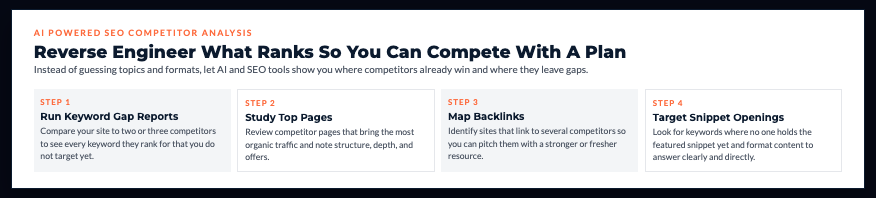
Tools like Semrush Social Media Tracker and Sprout Social show:
- How fast competitors grow their audiences
- Which posts get the most engagement
- Engagement rate percentages (engagement divided by followers)
- Best posting times based on competitor data
Key insight: A competitor with 50,000 followers but 0.5% engagement rate is less threatening than one with 5,000 followers and 8% engagement. The second one has a real community.
Content Strategy Patterns
AI analyzes hundreds of competitor posts to identify:
- Content type mix (educational, promotional, entertaining)
- Posting frequency (daily, 3x weekly, etc.)
- Format preferences (video, carousel, single image, text)
- Topic themes that repeat
- Hashtag strategies
You’re not manually reviewing every post. AI identifies patterns across months of content in minutes.
Platform Preference Insights
Some competitors crush it on Instagram but ignore LinkedIn. Others dominate LinkedIn but have no Instagram presence.
Understanding where competitors focus tells you:
- Where your audience hangs out
- Which platforms might be less competitive
- What content performs on each platform
If all competitors focus on one platform, you have two strategic options: compete there with better content, or dominate a platform they’re ignoring.
Competitor Content Strategy Analysis
Content is how most solopreneurs attract and convert customers. Understanding competitor content strategies saves months of trial and error.
Content Type and Format Analysis
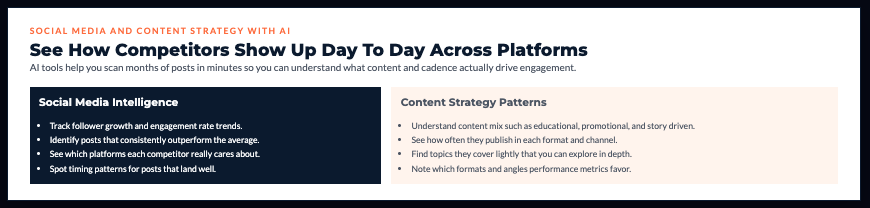
AI tools scan competitor blogs, YouTube channels, podcasts, and social media to identify:
- Content format distribution (70% blog posts, 20% videos, 10% podcasts)
- Topic categories they cover most
- Content depth (average word count, video length)
- Publishing frequency
Strategic decision: If competitors all focus on written content but video performs better in your niche, that’s an opportunity. Or if they all post weekly but you can post daily, volume becomes your advantage.
Publishing Frequency and Consistency
Successful competitors usually publish consistently. AI tracking shows you:
- How often they post (daily, weekly, monthly)
- Whether they maintain consistency
- Seasonal patterns in publishing
This sets realistic benchmarks. If top competitors post 2-3 times weekly and you’re posting once monthly, you’re probably not publishing enough to compete.
Topic and Theme Analysis
Understanding which AI competitor analysis tools can systematically identify content gaps helps you create what competitors haven’t covered well yet.
Tools like Ahrefs Content Gap and Semrush Topic Research identify:
- Topics competitors cover exhaustively
- Topics they mention briefly (opportunities for depth)
- Topics they don’t cover at all (gaps you can own)
One solopreneur analyzed five competitors in the productivity software space. All focused on features and workflows. None covered implementation and onboarding. She created a series on implementation and became the go-to resource for that angle.
Engagement and Performance Metrics
Not all competitor content performs equally. AI tools identify their winners:
- Most-shared blog posts
- Highest-traffic pages
- Videos with most views
- Social posts with most engagement
Study what works for them. Understand why it resonates. Then create your version that serves your audience better.
AI Tools for Competitor Pricing and Product Analysis
Pricing and positioning decisions shouldn’t be guesses. Competitor data informs smart choices.
Pricing Strategy Monitoring
Most competitors’ pricing is public. AI tools can track it over time:
- Price points for different tiers or packages
- Pricing changes and when they happen
- Discount patterns and frequency
- Seasonal pricing adjustments
Strategic application: If three competitors all charge $97-149 for similar services, pricing at $47 positions you as budget option. Pricing at $297 positions you as premium. Either can work, but you need to understand the competitive context.
Product Feature Comparison
AI tools can scan competitor websites to map feature sets:
- What’s included in each pricing tier
- Unique features they offer
- Features they all offer (table stakes)
- Features none of them offer (opportunities)
This helps you decide what to build or emphasize. If a feature exists in every competitor offering, you probably need it too. If a feature would be valuable but no one offers it, you’ve found differentiation.
Customer Feedback Analysis
Mining competitor reviews (Google, Trustpilot, G2, software review sites) reveals:
- What customers love (strengths to match or exceed)
- What customers complain about (weaknesses to exploit)
- Feature requests and unmet needs
- Deal-breakers and friction points
AI sentiment analysis processes hundreds of reviews to identify patterns. You see themes without reading every review manually.
Real example from solopreneurs: Someone analyzed competitor software reviews and found repeated complaints about poor customer support. She made exceptional support her main differentiator and captured customers frustrated with competitors.

Competitor Advertising and Marketing Intelligence
Understanding competitor ads tells you what’s working without spending your own ad budget testing.
Paid Search Analysis
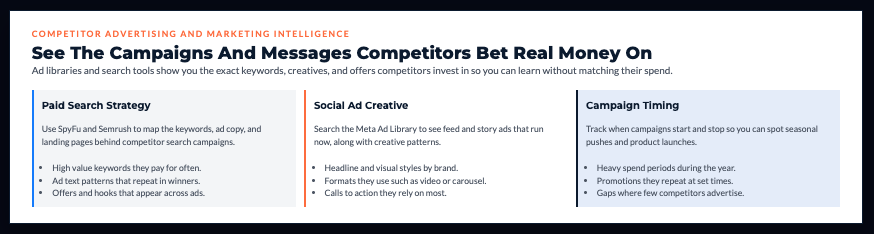
SpyFu and Semrush show you:
- Every keyword competitors bid on
- Their ad copy for each keyword
- Estimated ad spend and CPC
- Ad testing variations
- Landing pages ads send to
You see their entire paid search strategy. Their winners become your starting point. Their losers become lessons learned.
Ad Creative and Messaging
Facebook Ad Library (free) shows all ads competitors currently run on Facebook and Instagram. SpyFu shows Google Ads history.
What you learn:
- Headline formulas that work
- Value propositions they emphasize
- Offers and pricing they promote
- Visual styles and formats
- Calls to action they use
Don’t copy ads directly. But study what resonates and adapt the principles.
Campaign Timing and Strategy
AI tools reveal:
- When competitors run heavy ad campaigns (seasonal patterns)
- How long campaigns typically run
- Which promotions they repeat annually
- New offers they test
This informs your promotional calendar. If competitors all run big campaigns in Q4, that’s when your audience expects deals. Going quiet then means missing opportunity.
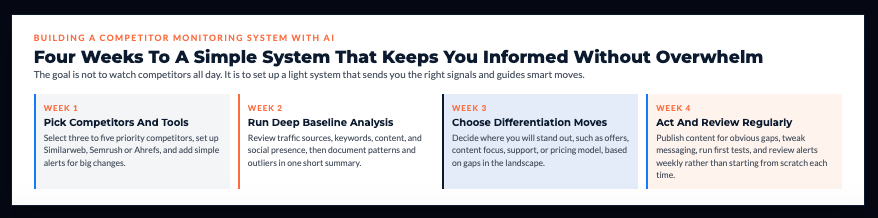
Building a Competitor Monitoring System with AI
One-time competitor research is useful. Ongoing monitoring is strategic.
Automated Alert Setup
Most AI tools let you set alerts for competitor activity:
- New content published
- Keyword ranking changes
- Backlinks gained or lost
- Website changes
- Ad campaigns launched
- Social media mentions
You’re not manually checking competitors daily. The system alerts you when something meaningful happens.
Regular Analysis Schedule
Weekly: Check top competitor ranking changes and new content Monthly: Review traffic trends, social growth, and content performance Quarterly: Deep analysis of strategy shifts, pricing changes, and market position
Consistency matters more than frequency. Pick a schedule you’ll actually maintain.
Priority Competitor Selection
You can’t deeply monitor every competitor. Pick 3-5 most relevant:
- Direct competitors (same audience, same solution)
- Aspirational competitors (where you want to be in 2-3 years)
- Emerging competitors (new entrants gaining traction)
Focus your monitoring on competitors that actually matter to your strategy.
Turning Competitor Data Into Smart Decisions
Data without action is just interesting information. Here’s how to use what you learn.
Differentiation Strategy
Competitor analysis shows you what everyone else does. Your job is to be different in ways that matter.
Framework:
- List what all competitors do similarly (industry standard practices)
- Identify your unique strengths and approaches
- Find gaps competitors don’t fill well
- Choose 2-3 differentiation points to emphasize
You can’t be different in every way. Pick a few meaningful differences and make them clear.
Content Gap Exploitation
If you discovered topics competitors don’t cover well, that’s your content strategy for the next 3-6 months. Create the best resources on those topics. Own that piece of the conversation.
Pricing Strategy Optimization
Set pricing based on:
- Competitive context (what similar solutions cost)
- Your positioning (budget, mid-market, or premium)
- Value delivered (features, support, results)
Being cheapest is a strategy. Being most expensive is a strategy. Being in the middle is often the worst position.
Feature Prioritization
Build what competitors are missing and customers are asking for. That’s your product roadmap.
Don’t chase feature parity. Chase solving problems competitors don’t solve well.
Your Action Plan: Start Monitoring Competitors This Week
Alright, you’ve got the roadmap. Time to actually use it.
Week 1: Foundation Setup
- Identify 3-5 competitors worth monitoring
- Pick 1-2 AI tools based on your budget (Similarweb free tier + ChatGPT, or Semrush/Ahrefs if you can invest)
- Set up accounts and connect competitor domains
- Run initial analysis to establish baseline
- Total time: 2-3 hours
Week 2: Deep Analysis
- Traffic and keyword analysis for each competitor
- Content strategy review (topics, formats, frequency)
- Social media presence assessment
- Pricing and positioning comparison
- Document findings and patterns
- Total time: 4-5 hours
Week 3: Strategic Planning
- Identify your top 3 differentiation opportunities
- List content gaps you can fill
- Determine pricing strategy based on competitive context
- Plan marketing channels based on what works for competitors
- Set up automated alerts for ongoing monitoring
- Total time: 2-3 hours
Week 4: Implementation
- Start creating content for identified gaps
- Adjust messaging to emphasize differentiation
- Launch first marketing tests on validated channels
- Review competitor alert data and adjust strategy
- Total time: Varies based on actions taken
Total analysis investment: 8-11 hours for intelligence that guides months of decisions
The Analysis That Matters Most
What’s the one strategic decision you’re facing right now where competitor data would give you confidence?
Maybe it’s:
- Pricing for a new service
- Which content topics to focus on
- What features to build next
- Which marketing channel to prioritize
- How to position yourself differently
Pick that one question. Use AI tools to analyze how competitors handle it. Look for patterns, gaps, and opportunities. Make your decision based on data instead of guessing.
Remember This
Competitor analysis isn’t about copying what works. It’s about understanding the landscape so you can make smarter choices.
The best competitors to study aren’t always the biggest ones. Sometimes the most valuable insights come from competitors one step ahead of you, not the massive players who operate at totally different scale.
Don’t get paralyzed by data. Use it to inform decisions, then act. Imperfect action based on good data beats perfect planning that never happens.
And here’s the most important part: your competitive advantage isn’t just using these tools. It’s combining the intelligence they provide with your unique strengths, perspective, and relationship with your audience.
As you start applying these insights, use the AI Blueprint to build a system that keeps your workflow simple and sustainable
I put together The AI Blueprint for Solopreneurs – a calm, structured guide that shows you how to use AI to simplify your systems and save time without losing your voice.
👇 Enter your email below to get your free copy.
It’ll be in your inbox within minutes – practical, focused, and built to help you work smarter.
Here’s My Question For You:
What’s the one competitor you’re gonna analyze deeply this week?
Not five competitors. Just one.
Use the tools and frameworks in this guide to understand their strategy. Traffic sources, content approach, positioning, what’s working, what customers complain about.
Then identify one thing you can do differently or better based on what you learned.
That’s how competitor intelligence becomes competitive advantage. Not through obsessive monitoring, but through strategic analysis that leads to better decisions.
Your future self (the one making confident strategic moves while competitors guess) is gonna thank you for starting today.
Now go do your homework on the competition.