AI Keyword Research Tools: Find Keywords That Actually Rank (Without the Guesswork)

Here’s a pattern I see all the time with solopreneurs.
They spend three weeks doing keyword research manually. Opening spreadsheet after spreadsheet. Copying data from one tool to another. Trying to figure out which keywords are worth targeting.
Then they finally pick their keywords, create content, and… nothing. Turns out they were chasing terms they had zero shot at ranking for. All that time wasted because they were flying blind.
That’s where AI keyword research tools changed everything. What used to take weeks now takes hours. What used to require expensive SEO consultants can now be done by solopreneurs who barely understand how Google works.
Here’s the thing most people don’t get: keyword research isn’t about finding the “perfect” keywords. It’s about finding the right keywords for you-the ones you can actually rank for, that bring in people ready to buy what you’re selling, and that don’t require a team of 10 to compete for.
In this guide, we’re breaking down why AI-powered keyword research matters, which tools actually deliver results, and how to find low-competition opportunities that your competitors are completely overlooking.
Before you dive into the tools, get the 3-step flow that turns your visibility efforts into consistent client demand.
The Predictable Client Flow breaks down the 3-step framework for creating steady, repeatable client growth without overcomplicating your marketing.
👇 Enter your email below to get it instantly.
You’ll get the full framework in your inbox – clear, focused, and easy to follow.
Why AI-Powered Keyword Research Matters for Solopreneurs
Organic traffic is the highest-ROI marketing channel available to solopreneurs. Period. When someone finds you through Google, they’re already looking for what you offer. You’re not interrupting their day with an ad or hoping they see your post in a crowded social feed.
But here’s where it gets interesting.
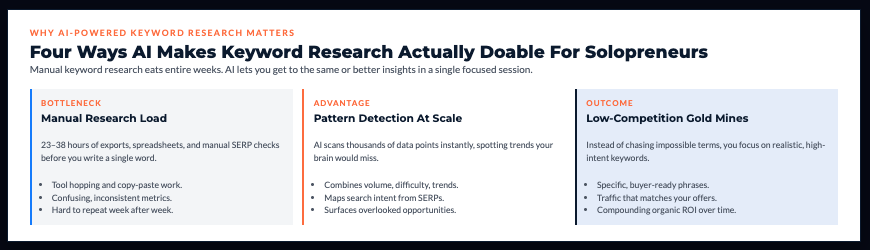
The Traditional Research Bottleneck
Manual keyword research looks like this:
- 10-15 hours searching for potential keywords
- Another 5-10 hours organizing data in spreadsheets
- 5-8 hours analyzing competition manually
- 3-5 hours trying to figure out search intent
Total: 23-38 hours of work before you even start creating content. For a solopreneur juggling everything else, that’s basically impossible to maintain consistently.
AI’s Competitive Advantage
AI processes thousands of data points in seconds-search volume, keyword difficulty, SERP features, competitor rankings, seasonal trends, search intent signals. It identifies patterns that would take your brain weeks to spot manually.
What typically happens: A solopreneur using AI tools knocks out comprehensive keyword research in 45-90 minutes that would’ve taken them two weeks manually. Same quality insights, 95% less time investment.
The competitive advantage isn’t subtle. While competitors are still manually pulling keyword data, AI users have already identified opportunities, created content, and started ranking.
Low-Competition Gold Mines
Here’s what makes AI powerful for solopreneurs specifically: it finds the keywords everyone else overlooks.
Imagine this scenario: You’re in the email marketing space. Everyone’s fighting for “email marketing tips” (impossible to rank for). But AI analysis reveals “email automation for Shopify stores under 100 orders” gets 200 monthly searches with a difficulty score of 12. Nobody’s targeting it specifically. That’s your opportunity.
These low-competition, high-intent keywords exist in every niche. AI finds them systematically instead of you stumbling across them randomly.
Search Intent Understanding
Volume doesn’t matter if you’re attracting the wrong people. AI helps you understand what people actually want when they search.
“Best CRM” could mean:
- Someone researching what CRM means (informational)
- Someone comparing options before buying (commercial)
- Someone ready to purchase right now (transactional)
AI analyzes the actual search results to tell you which intent Google thinks that keyword represents. You create content that matches that intent, which means you actually have a shot at ranking.
The ROI Reality
Let’s run the numbers on organic versus paid traffic:
Paid ads approach:
- $2,000-5,000 monthly ad spend
- Traffic stops the moment you stop paying
- Requires ongoing budget forever
Organic approach:
- Time investment upfront for keyword research and content
- Rankings and traffic continue indefinitely
- No ongoing costs once you rank
One successful solopreneur targeting 15 low-competition keywords ranks on page one for 12 of them within 6 months. Those 12 keywords drive 3,000 monthly visitors. To get 3,000 monthly visitors from ads would cost roughly $3,000-6,000 monthly depending on niche. From organic? Zero ongoing cost.
The math isn’t even close.
Best AI Keyword Research Tools
Let’s talk tools. Not all 47 options floating around. Just the ones that actually move the needle for solopreneurs.
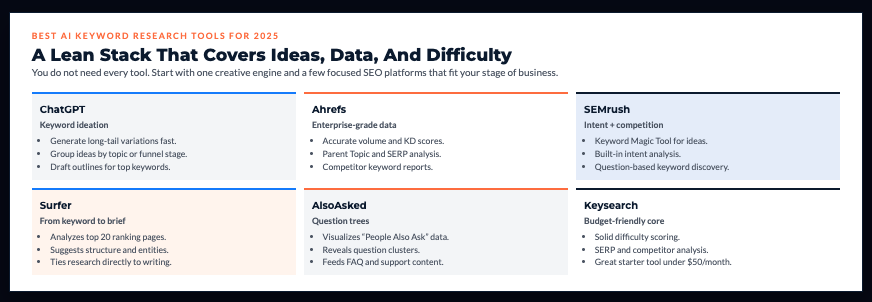
ChatGPT for Keyword Ideation (Free – $20/month)
ChatGPT is already sitting in your browser, and most people don’t realize how powerful it is for generating keyword variations.
How to use it: Prompt: “I’m targeting [your audience] in the [your niche] space. Generate 50 long-tail keyword variations around [your topic] that would have low competition and specific search intent.”
In 30 seconds, you’ve got a list that would take an hour to brainstorm manually. The key is being specific with your prompts-tell it your niche, your audience, what stage of the buyer journey you’re targeting.
When it’s worth upgrading to Plus ($20/month): If you’re doing keyword research weekly and hitting rate limits on the free version.
Ahrefs Keywords Explorer ($129/month)
Ahrefs is the heavyweight champion. Expensive, but the AI-powered opportunity identification is next level.
What you get:
- Search volume data for 10 billion+ keywords
- Keyword difficulty scores (realistic assessment of ranking potential)
- Parent Topic clustering (groups keywords targetable with one post)
- SERP analysis showing what actually ranks
- Competitor keyword tracking
Best for: Established solopreneurs making $5k+/month who are serious about SEO as a primary traffic channel.
When to skip it: You’re pre-revenue or just starting with SEO. Use free/cheaper tools first, upgrade when you’ve proven organic traffic works for your business.
SEMrush Keyword Magic Tool ($139/month)
SEMrush has a massive database-over 25 billion keywords across global markets.
Key features:
- AI clustering that groups related terms automatically
- Intent analysis (informational, commercial, transactional)
- Question-based keyword identification
- SERP feature tracking (featured snippets, PAA boxes)
The intent analysis is particularly valuable. It tells you whether people searching that term want to learn, compare products, or buy right now. That determines what type of content you create.
Worth it if: You need comprehensive keyword data plus competitor analysis and rank tracking in one platform.
Surfer SEO ($89/month)
Surfer connects keyword research directly to content recommendations. It doesn’t just tell you what keywords to target-it shows you exactly how to structure articles to rank for them.
The workflow:
- Enter your target keyword
- Surfer analyzes top 20 ranking pages
- It tells you: word count needed, headings to include, semantic keywords to use, content depth required
- You write following the blueprint
This integration between research and creation saves hours and dramatically improves your chances of actually ranking.
Best for: Solopreneurs who want keyword research and content optimization in one tool.
AlsoAsked (Free tier, $15/month paid)
AlsoAsked visualizes the questions people ask around your topic. It’s based on Google’s “People Also Ask” data.
Why it matters: Question-based keywords are often easier to rank for than broad terms. “How to choose email marketing software for coaches” is way less competitive than “email marketing software.”
The free tier gives you limited daily searches. Usually sufficient for solopreneurs doing weekly keyword research sessions.
AnswerThePublic (Free tier, $99/month pro)
AnswerThePublic shows you questions, prepositions, comparisons, and related searches for any topic. It’s essentially Google autocomplete data presented visually.
Strategic use:
- Content ideas based on real questions people ask
- Understanding search intent and concerns
- Discovering how people describe problems in their own words
The free version gives you a couple searches daily. That’s enough for most solopreneurs just starting out.
Keysearch ($49/month)
Keysearch is the budget option that doesn’t sacrifice quality. The AI difficulty scoring is solid, and for someone who can’t drop $100+/month on tools yet, it handles the fundamentals well.
What you get:
- Keyword difficulty analysis
- SERP analysis
- Rank tracking
- Competitor research
It’s not as comprehensive as Ahrefs or SEMrush, but it covers 80% of what most solopreneurs actually need for a fraction of the cost.
Finding Low-Competition Keywords with AI
This is where AI really shines for solopreneurs-finding keywords you can actually rank for without massive backlink profiles or years of domain authority.
Keyword Difficulty Analysis
AI assesses dozens of factors to give you realistic ranking potential:
- Domain authority of current ranking sites
- Their backlink profiles
- Content quality and depth
- SERP features present
- Historical ranking stability
General guidelines:
- Ahrefs difficulty under 30: Good opportunities for newer sites
- SEMrush difficulty under 50: Achievable with solid content
- Keysearch difficulty under 40: Target these first
These aren’t guarantees, but they give you much better odds than blindly guessing.
Long-Tail Keyword Mining
Instead of chasing “email marketing” (impossible for most solopreneurs), you target specific variations: “email marketing automation for Shopify stores” or “best email subject lines for coaching business.”
These specific phrases might only get 100-300 searches monthly individually. But here’s the math: rank for 20 of these long-tail terms, and you’re looking at 2,000-6,000 highly targeted monthly visitors.
If you want all this visibility to translate into steady client flow, this framework shows you exactly how to connect the dots.
You can see the steps here → Get The Predictable Client Flow Framework
AI workflow for finding long-tails:
- Start with your broad topic
- Use AI tools to generate 100+ variations
- Filter for difficulty under 30 and volume 100-1,000
- Analyze search intent to ensure match
- Prioritize by business relevance
Question-Based Keywords
Search terms starting with “how to,” “what is,” “why does,” “when should”-these typically have lower competition because everyone’s chasing the obvious head terms.
Plus, Google loves ranking detailed, helpful content for question queries. You can often capture featured snippets too, which doubles your visibility.
AI approach: Use AlsoAsked or AnswerThePublic to map question variations around your topic. Pick the ones with decent volume and low difficulty. Create comprehensive answers that directly address the question.
AI Gap Analysis
This is one of the most effective strategies for understanding which AI keyword research tools can systematically uncover opportunities-plug in 2-3 competitor URLs, and the AI shows you every keyword they rank for that you don’t.
It’s basically a cheat sheet of proven opportunities. You’re not guessing what might work-you’re seeing what’s already working for someone similar to you.
Practical workflow:
- Identify 3 competitors similar to your size/niche
- Run competitor gap analysis in Ahrefs or SEMrush
- Filter for keywords with difficulty under 40
- Sort by search volume (100-1,000 monthly)
- Create content targeting those gaps
Emerging Trend Keywords
AI tools can spot search terms growing in volume before they hit mainstream saturation. Getting in early means easier ranking and establishing authority before everyone else catches on.
Tools like Google Trends combined with ChatGPT interpretation help you identify which rising terms are temporary fads versus sustained growth opportunities.
Understanding Search Intent with AI
This is where most keyword strategies fall apart. Someone finds a keyword with good volume and low difficulty, creates content, and then… nothing. Why? Wrong intent.
The Four Types of Search Intent
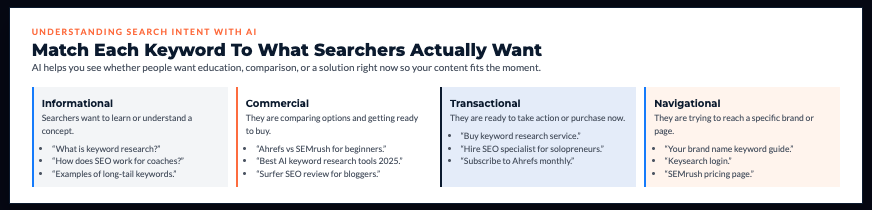
Informational intent – People want to learn something. “How does SEO work” or “what is keyword research.” They’re not buying yet-they’re educating themselves. Blog posts, guides, and tutorials target these.
Commercial intent – They’re considering a purchase but haven’t decided. “Best email marketing software” or “Ahrefs vs SEMrush.” They’re comparing options. Product comparison posts and review content work here.
Transactional intent – Ready to pull the trigger. “Buy Ahrefs subscription” or “hire SEO consultant Chicago.” Product pages, service pages, and landing pages target these terms.
Navigational intent – Searching for a specific brand or website. “Ahrefs login” or “ConvertKit pricing page.” Not much opportunity unless it’s your brand.
SERP Analysis with AI
AI tools analyze what’s currently ranking to tell you what Google thinks the intent is:
- If top 10 results are all listicles → informational intent
- If they’re all product pages → transactional intent
- If they’re all comparisons → commercial intent
You gotta match that intent or you won’t rank. Period.
Common mistake: Writing amazing blog posts targeting keywords where Google only ranks product pages. That content never had a chance. SERP analysis prevents this by showing you what type of content actually ranks before you invest time creating.
AI Tools for Keyword Clustering and Organization
Once you’ve got 200-500 keywords (which happens fast with AI), you need organization. Otherwise, you’ll create multiple posts that cannibalize each other’s rankings by targeting the same search intent.
Semantic Keyword Grouping
AI clusters related keywords into topic groups automatically. Instead of separate posts for “email automation,” “automated email sequences,” and “email workflow automation” (all the same intent), you create one comprehensive post targeting all three.
Why this matters: Google ranks pages, not keywords. One well-optimized page can rank for dozens of related terms if you structure it right.
Topic Authority Building
When you cover a subject comprehensively-hitting the main keyword plus all the related semantic terms-Google sees you as an authority on that topic. Your rankings improve across the board.
Strategic approach:
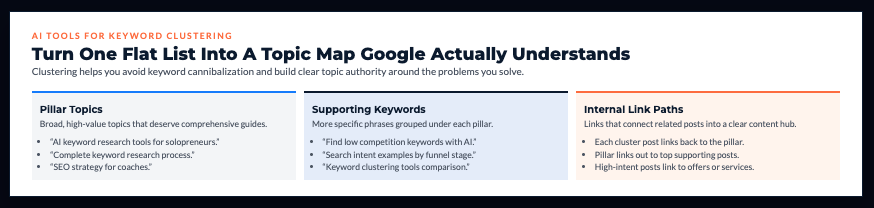
- Identify your main topics (5-10 core subjects)
- Use AI clustering to group all related keywords under each topic
- Create pillar content for main topics (comprehensive guides)
- Create supporting content for specific subtopics
- Link everything strategically
Content Pillar Planning
You’ve got main “pillar” posts-something like “The Complete Guide to Email Marketing for Coaches”-and supporting cluster content that links back to it.
AI helps identify which keywords should be pillars (high volume, broader topics) and which should be clusters (long-tail, specific questions).
The internal linking strategy basically writes itself when you organize keywords this way. Every cluster post links to the pillar. The pillar links to relevant clusters. Google follows those links and understands your site structure.
Keyword Cannibalization Detection
If you’ve got three posts all targeting “best CRM software,” they’re competing against each other in Google’s eyes. AI tools flag this automatically so you can consolidate or differentiate them.
Fix options:
- Merge similar posts into one comprehensive piece
- Differentiate by audience (best CRM for coaches vs. best CRM for agencies)
- Target different stages (what is CRM vs. best CRM vs. CRM setup guide)
Competitive Keyword Analysis with AI
Your competitors are giving you a roadmap if you know how to analyze it properly.
Competitor Keyword Gap Analysis
This shows you terms competitors rank for that you don’t. In Ahrefs, you enter your domain plus 2-3 competitors, and it generates hundreds of opportunities.
These are proven keywords-you already know they work because competitors are getting traffic from them.
Strategic filter: Focus on keywords where:
- Competitors rank in positions 3-10 (beatable)
- Difficulty is under 40 (achievable for you)
- Volume is 100-1,000 monthly (realistic targets)
- Intent matches your content capabilities
Content Quality Comparison
Tools like Surfer and Frase analyze top-ranking content and tell you: “These posts average 2,500 words, cover these 15 subtopics, use these semantic keywords, and have this reading level.”
Now you know exactly what “good enough to rank” looks like. You’re not guessing-you’re following a blueprint.
Backlink Profile Insights
If every ranking page has 50+ referring domains and you’ve got 5, you probably need a different strategy. Either build links first, or find easier keywords.
AI makes this visible upfront so you don’t waste months chasing impossible rankings.
SERP Feature Opportunities
Featured snippets, “People Also Ask” boxes, video carousels-these give you extra visibility beyond just ranking. AI identifies which keywords have these opportunities and what format Google wants (lists, tables, definitions).
Capturing a featured snippet can double your click-through rate even if you’re ranking #3 or #4.
Integrating AI Keyword Research with Content Creation
The gap between research and creation is where most people lose momentum. You’ve got this beautiful spreadsheet of keywords… and then what?
Content Brief Generation
Tools like Frase and Surfer take your target keyword and generate a complete outline:
- What headings to include
- What questions to answer
- What related terms to weave in naturally
- How long the content should be
- What format works best (list, guide, comparison)
You’re not staring at a blank page anymore. You’ve got a blueprint.
Semantic Keyword Inclusion
AI identifies related terms you should naturally include beyond your main keyword. If you’re writing about “cold email outreach,” related terms to include:
- Email deliverability
- Subject line testing
- Follow-up sequences
- Response rates
- Spam filters
This topical coverage signals to Google you actually know what you’re talking about, not just trying to rank for one specific phrase.
Word Count Recommendations
AI analyzes the current top 10 and tells you average depth. If everyone ranking publishes 3,500-word comprehensive guides, your 1,000-word post isn’t gonna cut it.
This isn’t arbitrary “aim for X words” advice. It’s data showing you what level of depth Google expects for that particular keyword.
Featured Snippet Optimization
If your target keyword has a featured snippet, AI tools show you exactly what format the current snippet uses:
- Definitions: 40-60 word paragraphs
- Steps: Numbered lists with clear instructions
- Comparisons: Tables with direct attribute comparisons
Format your content to match or beat that structure, and you’ve got a shot at stealing the snippet.
Common AI Keyword Research Mistakes to Avoid
Even with AI doing heavy lifting, these mistakes still happen constantly based on patterns I’ve observed.
Volume Obsession
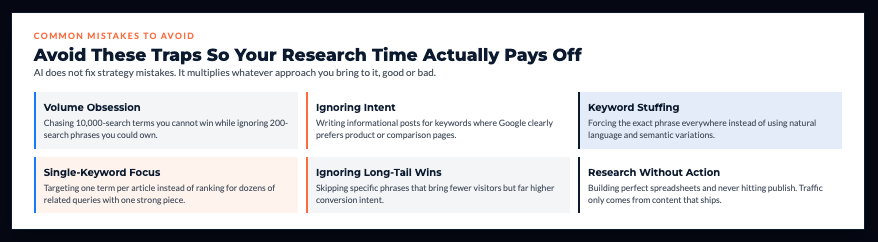
Someone sees a keyword getting 10,000 searches monthly and ignores one getting 200. But if you can’t rank for the 10,000-search term, that traffic is theoretical. The 200-search term you can rank for brings actual visitors.
Better approach: Prioritize keywords you can win, not keywords that look impressive in spreadsheets.
Ignoring Search Intent
Finding a keyword, checking volume and difficulty, writing content, and wondering why it’s not ranking. Then looking at the SERP and realizing you wrote a blog post but Google only ranks product pages for that term.
Match the intent or don’t bother creating content.
Keyword Stuffing
Some people still think “I need to use this keyword 47 times” and end up with robotic, unreadable content.
AI tools give you semantic keywords specifically so you don’t have to force the exact phrase everywhere. Use variations, synonyms, related terms. Write for humans first, optimize for search engines second.
Single Keyword Focus
Every piece of content should target a primary keyword plus 5-10 related terms. That one article can rank for dozens of different searches if you structure it right.
AI clustering shows you these opportunities-don’t ignore them.
Neglecting Long-Tail Opportunities
It’s usually about ego. People want to rank for big, prestigious terms in their industry. But 70% of searches are long-tail-super specific phrases with low volume individually that add up to massive traffic collectively.
Those are your quick wins. String together enough of them and you’ve got real traffic.
Research Without Action
This might be the most painful pattern to watch. Someone spends weeks finding perfect keywords, building content calendars, organizing everything… and then never publishes the content.
Research doesn’t matter if you don’t execute. Pick your top 10 keywords and start creating. You can always research more later.
Your Action Plan: Start Finding Keywords That Actually Work
Alright, you’ve got the roadmap now. You understand why AI keyword research matters, which tools deliver results, how to find low-competition opportunities, and mistakes that waste months of effort.

Week 1: Tool Selection & Setup
- Pick one AI tool and actually use it
- If you’re on a budget: Keysearch ($49/month) or ChatGPT (free)
- If you can invest: Ahrefs ($129/month) or SEMrush ($139/month)
- Don’t comparison shop for six months-pick one and learn it
- Total time: 2-3 hours
Week 2: Initial Keyword Research
- Find 20-30 low-competition keywords in your niche
- Use strategies we covered: long-tail terms, question keywords, competitor gaps
- Look for difficulty under 30-40, volume 100-1,000
- Verify search intent matches your content capabilities
- Total time: 3-4 hours
Week 3: Organization & Prioritization
- Group keywords into topic clusters
- Identify 3-5 pillar topics and supporting content ideas
- Prioritize based on business relevance and ranking potential
- Create content briefs for top 5 keywords
- Total time: 2-3 hours
Week 4: Content Creation
- Write and publish content for 3 keywords this month
- Not next month. This month.
- Even if it’s not perfect
- Published content ranking on page two beats perfect content stuck in drafts
- Total time: 6-10 hours
Total investment: 13-20 hours for a foundation that drives traffic indefinitely
The Keywords That Matter Most
What’s the one topic where you need to be found in search?
Not ten topics. Just one.
Maybe it’s:
- Your main service offering
- A problem your product solves
- A comparison between solutions in your space
- A “how to” guide related to your expertise
Use AI tools to find 10 keyword variations around that one topic. Target difficulty under 40, volume 100-500. Create comprehensive content for your top 3.
That’s your foundation. Rank for those 3 terms, and you’ve proven organic traffic works for your business. Then scale from there.
Remember This
Keyword research isn’t about achieving perfect knowledge of every possible search term. It’s about finding opportunities you can realistically capitalize on with your current resources.
AI tools don’t eliminate the need for judgment. They reduce uncertainty to a manageable level where you can act with reasonable confidence.
The solopreneurs winning with SEO aren’t the ones with the biggest tool budgets or most sophisticated strategies. They’re the ones consistently finding opportunities, creating solid content, and showing up.
As you build consistency with SEO, use this simple flow to turn that visibility into steady client conversations
The Predictable Client Flow breaks down the 3-step framework for creating steady, repeatable client growth without overcomplicating your marketing.
👇 Enter your email below to get it instantly.
You’ll get the full framework in your inbox – clear, focused, and easy to follow.
Don’t let research become procrastination. Use AI to identify opportunities quickly, then create content that serves searchers better than what’s currently ranking.
Here’s My Question For You:
What’s the one keyword you’re gonna research and create content for this month?
Not twenty keywords. Just one.
Use the tools and strategies in this guide to find a low-competition opportunity with real search volume. Create the best piece of content you can on that topic. Publish it.
Then measure what happens over the next 30-60 days. That’s how you learn what works for your specific business and audience.
Perfect keyword research doesn’t exist. But good enough research combined with quality content and consistent execution? That builds organic traffic that compounds over time.
Your future self-the one getting consistent traffic from Google without paying for ads-is gonna thank you for starting today.
Now go find your keywords and start ranking.