AI Website Copywriting: Write Converting Web Copy Without the Struggle

Here’s a common scenario with solopreneurs building their websites.
They know their website copy matters. They’ve read that good copy converts visitors into clients. They understand that unclear messaging loses business.
But when they sit down to actually write the homepage, about page, and service descriptions, everything gets harder. What should the headline say? How do you explain what you do without sounding like everyone else? What makes someone actually click the “Contact” button?
After hours of writing, deleting, rewriting, and second-guessing, they end up with copy that’s either too vague (“I help businesses succeed”) or too wordy (three paragraphs explaining what could be said in one sentence).
That’s where AI website copywriting changes the entire process. What used to take weeks of agonizing over every word now takes hours. You tell the AI what you do, who you serve, and what makes you different. It generates solid copy. You customize it with your voice and specific examples. Done.
This isn’t about replacing strategic thinking with robots. It’s about removing the blank page paralysis that stops most solopreneurs from having website copy that actually converts visitors into clients.
Let’s break down why website copy matters so much, which AI tools actually help, and how to use them without your site sounding generic.
Before you dive into the tools, get the blueprint that helps you use AI with clarity and structure across your business.
I put together The AI Blueprint for Solopreneurs – a calm, structured guide that shows you how to use AI to simplify your systems and save time without losing your voice.
👇 Enter your email below to get your free copy.
It’ll be in your inbox within minutes – practical, focused, and built to help you work smarter.
Why AI Website Copywriting Matters for Solopreneurs
Your website is working 24/7. Bad copy means it’s working against you. Good copy means it’s generating leads while you sleep.
The Copywriting Skills Gap
Most solopreneurs are great at what they do. They’re skilled consultants, talented designers, expert developers, experienced coaches. But writing persuasive copy? That’s a completely different skill set.
What typically happens: Someone visits your website. They land on your homepage. The headline says something vague like “Business Solutions That Work.” They’re confused about what you actually do. They leave within 10 seconds.
Or the opposite problem: Your copy explains everything in painful detail. Three dense paragraphs about your methodology before you even say what problem you solve. Visitors get overwhelmed and bounce.
Both scenarios lose business. Clear, persuasive copy is the difference between a website that converts and one that just exists.
Conversion Impact Reality
Here’s the brutal math: If 1% of visitors become clients with your current copy, improving to 2% doubles your business from the same traffic. That’s not doubling your marketing spend or your work hours. That’s just better copy.
Real conversion scenarios:
Scenario A (bad copy):
- 1,000 monthly website visitors
- 1% conversion rate
- 10 new leads monthly
- 3 close as clients
- Lost revenue from 997 visitors who left confused
Scenario B (good copy):
- Same 1,000 visitors
- 3% conversion rate (very achievable with clear copy)
- 30 leads monthly
- 9 clients
- 3x the business from identical traffic
Better copy isn’t marginal improvement. It’s business-changing improvement.
Professional Copywriter Costs
Hiring a professional copywriter to write your full website:
- Homepage: $1,000-2,000
- About page: $500-1,000
- 3-5 service pages: $2,000-4,000
- Total: $3,500-7,000+
For bootstrapped solopreneurs, that’s significant capital. Plus you wait 2-4 weeks for delivery, then another week for revisions.
With AI website copywriting tools, you’re looking at $0-50/month for the software plus 5-10 hours of your time. Even valuing your time at $100/hour, you’re at $500-1,000 total cost.
The economic case is clear. AI doesn’t replace strategy, but it removes the financial barrier to professional-quality copy.
Time Investment Problem
Writing effective website copy manually involves:
- Researching your audience and competitors: 4-6 hours
- Drafting homepage copy: 3-5 hours
- Writing about page: 2-4 hours
- Creating service pages: 5-8 hours per page
- Revision and refinement: 5-8 hours
Total: 25-40 hours minimum for a basic website.
With AI tools:
- Strategic planning (what to communicate): 2-3 hours
- AI generation with customization: 5-8 hours
- Final polish and voice consistency: 3-5 hours
Total: 10-16 hours for the same result. You’re saving 15-25 hours while getting better copy because AI knows proven frameworks.
If you’re seeing what’s possible, the AI Blueprint helps you build a simple system so AI supports your whole business, not just your copy.
You can explore it here → See What’s Inside The AI Blueprint for Solopreneurs
Best AI Website Copywriting Tools
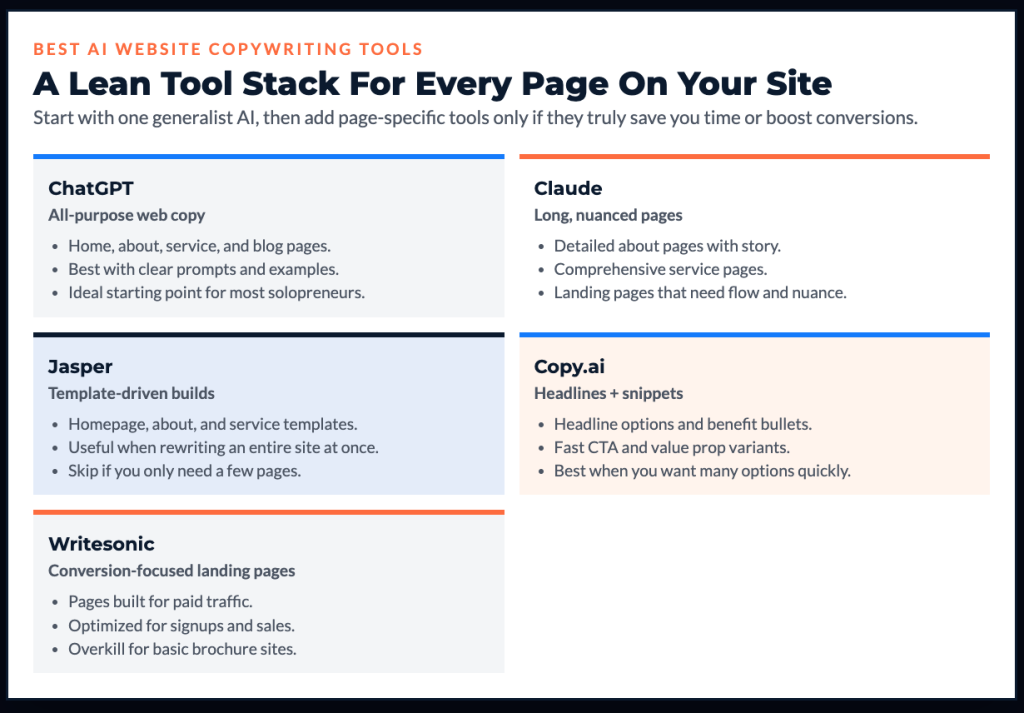
Let’s focus on tools that actually deliver quality website copy, not just generic text generation.
ChatGPT for Website Copy (Free, $20/month for Plus)
ChatGPT handles comprehensive web content across all page types. It’s the most versatile starting point.
How to use it effectively: “Write homepage copy for [your business type] serving [target audience]. Include a clear headline stating the main benefit, a subheadline explaining how you deliver it, three key benefits with brief explanations, and a strong call to action. Professional but approachable tone. 200-250 words.”
The more context you provide, the better the output. Include details about your audience’s problems, your unique approach, and desired tone.
When to upgrade to Plus: If you’re creating multiple pages and hitting rate limits, or you want access to GPT-4 for higher quality copy.
Claude for Long-Form Web Copy (Free, $20/month for Pro)
Claude excels at longer pages that need to maintain consistent tone and logic flow. When you’re writing detailed service pages or comprehensive about pages, Claude often delivers more coherent results.
Best use cases:
- About pages that tell your full story (400-600 words)
- Detailed service descriptions with multiple sections
- Landing pages that need persuasive flow
- Copy requiring nuance and careful positioning
Jasper Website Templates ($49/month)
Jasper has pre-built templates for every website page type. Homepage template, about page template, service page template, landing page template.
Worth it if: You’re building or rewriting your entire website and the templates save you 5+ hours compared to prompting ChatGPT from scratch repeatedly.
Skip it if: You’re just updating a few pages and ChatGPT meets your needs at $0-20/month.
Copy.ai Website Tools ($49/month)
Copy.ai focuses on quick generation of specific copy elements. Headlines, CTAs, benefit statements, feature descriptions.
Best for: Speed over customization. If you need to generate multiple headline options fast or quickly draft various page sections, Copy.ai delivers. If you want highly nuanced full-page copy, ChatGPT gives you more control.
Writesonic Landing Pages ($49/month)
Writesonic specializes in conversion-focused copy. It’s tuned for landing pages, sales pages, and copy designed to drive specific actions.
Makes sense for: Solopreneurs running paid traffic to landing pages where conversion rate directly affects ROI. The optimization focus justifies the cost.
Not worth it for: Basic service websites where you mostly need clear explanations, not aggressive conversion tactics.
Writing Homepage Copy That Hooks Visitors
Your homepage has one job: make people understand what you do and why they should care within 5-10 seconds.
Above-the-Fold Messaging
The content visible before scrolling determines whether people stay or leave.
Essential elements:
- Headline stating the main benefit (not your company name or tagline)
- Subheadline adding context or how you deliver the benefit
- Visual supporting the message
- Clear call to action button
AI prompt that works: “Write above-the-fold homepage copy for [business type] serving [audience]. Headline should state the main benefit customers get. Subheadline should explain how we deliver it. Professional, clear, benefit-focused. 15-25 words for headline, 25-40 words for subheadline.”
Value Proposition Clarity
People should understand what you do within seconds. No cleverness, no mystery, no making them work to figure it out.
Bad value prop: “Empowering transformation through innovative solutions”
Good value prop: “Custom software development for manufacturing companies. We build tools that reduce production errors by 30%+.”
The difference: specificity. Who you serve, what you deliver, what outcome they get.
Problem-Solution Framework
Start with the problem your audience feels, then position your service as the solution.
Structure AI generates well:
Problem statement: “Struggling with [specific pain point]? You’re not alone. Most [audience] deal with [problem] because [reason].”
Your solution: “We solve this by [your approach]. Instead of [old way that doesn’t work], we [your method].”
Outcome: “The result? [Specific benefit]. Our clients typically see [measurable outcome].”
This framework works because it matches how people think. They come to your site with a problem. Your copy acknowledges that problem, explains your solution, and describes the outcome.
About Page Copy That Builds Trust
Your about page isn’t about you. It’s about why someone should trust you to solve their problem.
Origin Story Structure
People connect with stories. AI can structure the narrative even though you provide the actual story details.
Effective structure:
- Hook: Start with why you started this business (the problem you saw or experienced)
- Journey: Brief background establishing credibility
- Philosophy: What you believe about your industry or approach
- Today: What you do now and who you serve
- Transition: How the reader can work with you
AI prompt: “Structure an about page for [your business] targeting [audience]. Start with the founding story focusing on [problem that motivated you], establish credibility through [relevant background], explain the unique approach of [your method], describe current focus serving [audience], and end with clear next step.”
Credibility Establishment
You need to establish expertise without sounding like you’re bragging or listing every credential.
What works:
- Relevant experience directly related to solving client problems
- Specific results you’ve helped clients achieve
- Recognition or credentials that build trust
- Years in the industry (if it’s meaningful)
What doesn’t work:
- Resume dump of everything you’ve ever done
- Credentials unrelated to current business
- Generic claims without proof
- Talking about yourself without connecting to client value
Personal Connection
Balancing professionalism with humanity. People want to know you’re competent but also relatable.
Include:
- Why you actually care about this work
- What frustrates you about how others approach it
- What gets you excited about helping clients
- Maybe brief personal detail that humanizes you
AI generates this with prompting: “Add a personal section to this about page explaining why I’m passionate about [your work], what frustrates me about [industry problem], and brief personal detail about [hobby or interest that adds dimension].”
Service and Product Page Copywriting
Service pages convert when they clearly explain what someone gets and why it matters.
Feature-to-Benefit Translation
Features describe what you do. Benefits describe what clients get. Benefits convert better.
Feature: “Weekly coaching calls”
Benefit: “Weekly coaching calls so you have consistent support and accountability as you build your business”
Feature: “Custom website design”
Benefit: “Custom website design that represents your brand professionally and converts visitors into clients”
AI tools naturally translate features to benefits when you prompt: “Take this feature list and rewrite each as a client benefit.”
Process Explanation
People hesitate when they don’t understand what working together actually looks like.
Effective process section:
Step 1: [Discovery/Consultation] – What happens in this first step and what client provides
Step 2: [Strategy/Planning] – How you develop the approach and what client can expect
Step 3: [Execution/Delivery] – The actual work and timeline
Step 4: [Results/Follow-up] – What happens after and ongoing support
Breaking it into clear steps removes uncertainty and makes saying yes easier.
Objection Handling
Address concerns before they become reasons not to hire you.
Common objections to handle:
- “How long does this take?” (timeline concerns)
- “What if it doesn’t work?” (risk concerns)
- “Can’t I just do this myself?” (DIY alternative)
- “Is this really worth the investment?” (value concerns)
AI approach: “Write an FAQ section addressing these concerns about [your service]: timeline expectations, what happens if results don’t meet expectations, why DIY alternatives often fail, and investment value justification.”

Sales and Landing Page Copy Creation
Landing pages have one goal: convert visitors into leads or customers. The copy structure reflects that singular focus.
Problem-Agitate-Solve Framework
Make the problem feel real and urgent, then present your solution.
Problem: Establish the pain point clearly
Agitate: Make it worse by explaining consequences of not solving it
Solve: Present your offer as the solution
AI generates this structure: “Create landing page copy for [offer] using problem-agitate-solve framework. Target audience: [description]. Main problem: [pain point]. Agitate by explaining: [consequences]. Solution: [your offer]. Include pricing and CTA.”
Headline Formulas
Your landing page headline determines whether people keep reading.
Formulas that work:
Outcome focused: “Get [desired result] in [timeframe] without [common obstacle]”
Problem solved: “Finally, [solution to problem] without [usual pain]”
Transformation: “From [current state] to [desired state] in [timeframe]”
AI generates variations: “Generate 5 landing page headlines for [offer] targeting [audience]. Use outcome-focused, problem-solved, and transformation formulas. Each headline 10-15 words.”
Urgency and Scarcity
Creating genuine motivation to act now instead of “thinking about it.”
Legitimate urgency:
- Limited-time pricing
- Enrollment caps
- Seasonal availability
- Deadline-based bonuses
Fake urgency (avoid):
- Artificial scarcity
- Countdown timers that reset
- “Only 2 spots left!” that’s always true
Good copy creates urgency through value and timing, not manipulation.
Optimizing Website Copy for SEO with AI
Copy that converts visitors and ranks in search requires balancing human persuasion with search engine optimization.
Keyword Integration
Including search terms naturally without stuffing or awkward phrasing.
AI approach: “Rewrite this homepage copy to naturally include these keywords: [list]. Maintain conversational tone and clarity. Don’t force keywords where they sound unnatural.”
The goal: keywords appear where they make sense, not where they’re jammed in for SEO.
Meta Description Writing
The snippet that appears in search results. This copy determines whether people click through.
Effective meta descriptions:
- 150-160 characters (Google’s display limit)
- Include primary keyword
- State clear benefit or value
- End with call to action when appropriate
AI prompt: “Write a 155-character meta description for [page type] about [topic]. Include keyword [term] naturally. Focus on benefit to searcher. Make them want to click.”
Header Structure
Using H1, H2, H3 tags for both readability and SEO.
Best practice:
- H1: Main headline (one per page, includes primary keyword)
- H2: Major section breaks (naturally include related keywords)
- H3: Subsections under H2s
AI tools structure this automatically when you prompt: “Organize this copy with proper heading hierarchy. H1 for main headline, H2 for major sections, H3 for subsections.”
Call-to-Action Copy That Converts
Your CTA tells people exactly what to do next. Weak CTAs lose conversions.
Button Text Optimization
Moving beyond generic “Submit” and “Click Here.”
Weak CTAs:
- Submit
- Click Here
- Learn More
- Enter
Strong CTAs:
- Get Your Free Consultation
- Download the Guide Now
- Start Your Free Trial
- Schedule Your Strategy Call
- Claim Your Discount
The difference: strong CTAs tell people what they get, not just what to do.
Value-Focused CTAs
Emphasizing the outcome of clicking, not the action of clicking.
Action-focused: “Schedule a call”
Value-focused: “Get a custom strategy for your business”
Action-focused: “Download now”
Value-focused: “Get the free guide that shows you exactly how to [outcome]”
Value-focused CTAs convert better because they answer the question “what’s in it for me?”
Multiple CTA Strategy
Not everyone’s ready for the same commitment level. Offer options.
High commitment: “Schedule a consultation” (for people ready to talk)
Medium commitment: “Download our case study” (for people researching)
Low commitment: “Subscribe for tips” (for people not ready yet)
Having CTAs at different commitment levels captures more conversions overall.
Editing and Refining AI-Generated Website Copy
AI gives you a solid draft. Your job is making it sound like you and optimizing for conversion.
Brand Voice Consistency
Training AI to match your communication style.
Approach: “Here are three examples of my best copy: [paste examples]. Analyze the tone, vocabulary, sentence structure, and personality. Now rewrite this homepage copy matching that voice.”
The AI learns what makes your voice distinct and applies it to new copy.
Clarity Checks
Removing jargon and simplifying complex ideas.
Test your copy:
- Read it out loud (does it sound natural?)
- Show someone unfamiliar with your industry (do they understand it?)
- Remove any word that could confuse someone
- Replace industry terms with plain language
AI can help: “Rewrite this copy at an 8th-grade reading level. Remove jargon. Use simple, clear language. Maintain professionalism.”
Authenticity Editing
Adding touches AI can’t replicate.
What to add:
- Your specific examples and case studies
- Real client quotes and results
- Your unique perspective on industry issues
- Personal stories that illustrate your approach
- Specific numbers and data from your business
Generic copy with specific examples becomes compelling copy.
Website Copy Frameworks and Formulas
Proven structures that guide persuasive copy. AI tools work best when you specify a framework.
AIDA Framework
Attention, Interest, Desire, Action. Classic structure that works.
Attention: Hook with headline or opening statement
Interest: Build interest by explaining problem or opportunity
Desire: Create desire by showing benefits and outcomes
Action: Clear CTA telling them what to do next
AI prompt: “Write homepage copy using AIDA framework for [business]. Attention: [hook]. Interest: [problem explanation]. Desire: [benefit focus]. Action: [specific CTA].”
PAS Formula
Problem, Agitate, Solve. Particularly effective for service businesses.
Problem: State the pain point clearly
Agitate: Make it worse by discussing consequences
Solve: Present your service as the solution
This framework works because it matches how people think when they have problems. They’re looking for solutions that understand their specific pain.
Before-After-Bridge
Transformation-focused persuasion. Great for coaching, consulting, courses.
Before: Current painful situation
After: Desired future state
Bridge: Your service is the bridge between them
Example structure:
Before: “You’re spending 20 hours weekly on [task] and still falling behind…”
After: “Imagine having [task] handled automatically while you focus on [high-value work]…”
Bridge: “Our [service] gets you from overwhelmed to efficient in [timeframe]…”
Your Action Plan: Write Your Website Copy This Week
Alright, you’ve got the complete framework. You understand why website copy matters, which AI tools help, and how to structure effective copy.
This Week: Rewrite Your Homepage
Day 1: Strategic Planning (2 hours)
- Define your clear value proposition
- List your target audience’s main problems
- Identify your unique solution approach
- Outline key benefits clients get
- Choose your main CTA
Day 2: Generate First Drafts (2 hours)
- Pick one AI tool (ChatGPT works great for free)
- Generate homepage headline and subheadline (5 variations each)
- Create above-the-fold section
- Draft benefits section
- Write initial CTA copy
Day 3: Customize and Refine (2 hours)
- Add your specific examples
- Insert real client results
- Match to your brand voice
- Remove any generic language
- Ensure clarity throughout
Day 4: Polish and Publish (1 hour)
- Read entire page out loud
- Check for flow and logic
- Verify all CTAs work
- Test on mobile
- Publish updated homepage
Total investment: About 7 hours for homepage that actually converts
The Page That Matters Most
What’s the one page on your website losing you the most business right now?
Not all pages. Just one.
Maybe it’s:
- Homepage with vague value proposition
- About page that’s just a resume
- Service page that lists features without benefits
- Contact page with zero persuasion
Pick that one page. Use AI to rewrite it this week. Apply the frameworks and principles from this guide. Publish it.
Then track what changes. Notice if contact form submissions increase. See if people spend more time on the page. Watch whether more visitors take action.
That’s how you learn what works for your specific audience and business.
Remember This
AI website copywriting tools don’t make you less strategic. They remove the blank page paralysis and copywriting skill gap that was keeping you from having website copy that actually converts.
Your understanding of your audience, your unique approach, your specific results are what matter. AI just helps you articulate them clearly and persuasively without spending weeks writing and rewriting.
The solopreneurs with websites that convert aren’t the ones with the best writing skills. They’re the ones with clear messaging that addresses real problems and makes taking action easy.
As you refine your website, use the AI Blueprint to build a clear, simple workflow that supports your whole business.
I put together The AI Blueprint for Solopreneurs – a calm, structured guide that shows you how to use AI to simplify your systems and save time without losing your voice.
👇 Enter your email below to get your free copy.
It’ll be in your inbox within minutes – practical, focused, and built to help you work smarter.
Here’s My Question For You:
What’s the one page you’re gonna rewrite with AI this week?
Not your entire website. Just one page that’s currently hurting your business.
Pick your tool. Use the frameworks from this guide. Generate drafts. Customize with your voice and examples. Publish it.
Then measure what happens. That’s how you build a website that works for your business instead of just existing online.
Your future self, the one with website copy that actually converts visitors into clients, is gonna thank you for starting today.
Now go write copy that works.


